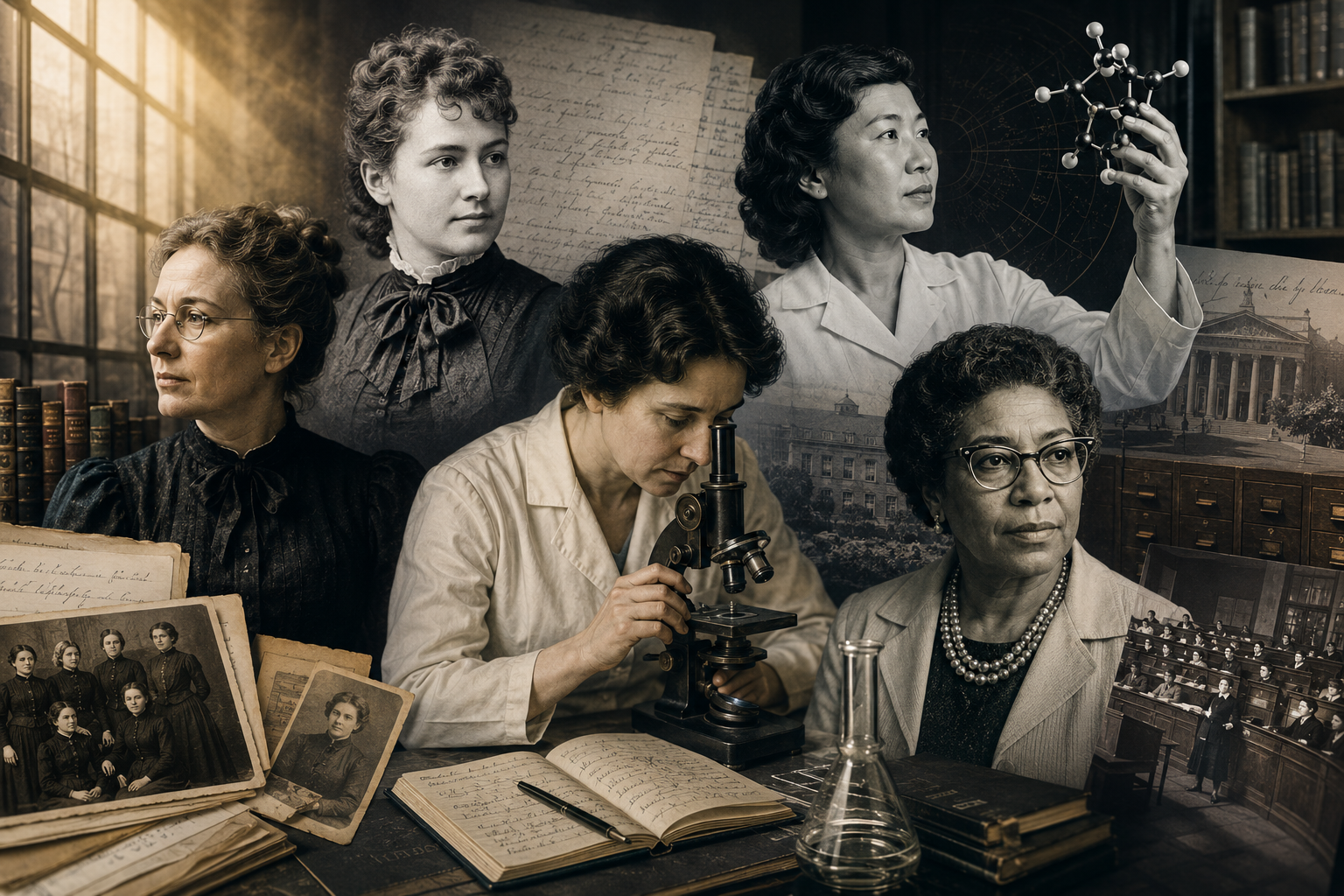
Why Were So Many Women Scientists Written Out of History?
The problem was not simply that history forgot women. Scientific institutions also shaped whose work became visible enough to remember.
The problem was not simply that history forgot women. For generations, the institutions that produced science also helped determine whose work became visible enough to remember.
History has a filing system.
Some scientists acquire professorships, laboratories, prizes, institutions bearing their names and long lists of publications. Their correspondence is preserved. Their portraits hang in universities. Their discoveries become attached to surnames that generations of students are required to memorise.
Others leave considerably less behind: a laboratory notebook, a name in the acknowledgements, a photograph in which they are standing conveniently outside the centre of the frame, an experiment remembered principally because somebody more senior explained its significance.
Eventually, history arrives to tidy things up.
It likes a protagonist. Science rarely supplies one.
Scientific discoveries emerge from experiments, arguments, instruments, calculations, technicians, students, collaborators, competitors and previous discoveries. Yet when this complicated process becomes history, much of that structure disappears.
We remember Newton, Darwin, Einstein, Pasteur and Turing. The names are not undeserved. The problem begins when a name becomes a substitute for the scientific system around it.
For women, that compression had particular consequences.
For much of modern scientific history, women encountered restrictions at almost every stage through which scientific authority was created. They struggled to enter universities, obtain degrees, secure paid positions, join professional societies, lead laboratories and control research programmes. Marriage and employment restrictions could interrupt careers. Laboratory hierarchies could separate the person producing evidence from the person publicly interpreting it.
Then historians inherited the records those institutions produced.
This creates a tempting explanation: women made discoveries, men stole the credit, history forgot the women.
Sometimes something uncomfortably close to that happened.
Usually, the mechanism was more complicated.
The more revealing question is not simply why particular women disappeared from scientific history.
It is how a scientist becomes somebody history is capable of remembering.
First, You Had to Get Into the Room
Before somebody could be denied scientific credit, she could be denied access to science itself.
For centuries, European universities were overwhelmingly male institutions. Restrictions varied by country and period, but women frequently could not matriculate on equal terms, obtain the same degrees or enter the professional pathways universities provided.
This mattered for considerably more than education.
Universities provided laboratories, libraries, instruments, mentors, credentials and colleagues. They placed researchers inside networks through which scientific information and professional opportunity travelled.
Exclusion from universities was therefore exclusion from infrastructure.
Women found ways around it, although that phrase disguises an extraordinary amount of effort.
Sofia Kovalevskaya wanted to study mathematics at a level unavailable to women in Russia. She travelled to Germany, where Heidelberg allowed her to attend lectures with the permission of individual professors. Berlin would not formally admit her, so Karl Weierstrass taught her privately. She eventually received a doctorate from Göttingen in 1874 and later became a professor in Stockholm.
Several decades later, Emmy Noether encountered a different version of the same architecture.
Noether became one of the most important mathematicians of the twentieth century. Her theorem connecting continuous symmetries with conservation laws became fundamental to modern physics. Yet early in her career at Göttingen she taught without the normal status or salary of a professor, and some of her courses initially appeared under David Hilbert's name because she could not formally qualify to teach there.
The absurdity was not lost on Hilbert. When colleagues objected to a woman joining the faculty, he reportedly asked whether the university was a bathhouse.
The joke survived.
More importantly, so did Noether's mathematics.
But "overcoming barriers" is an unsatisfactory way to describe what happened. It makes institutional obstruction sound like another examination the exceptional candidate successfully passed.
A male mathematician of comparable ability did not need exceptional ingenuity merely to enter the profession.
And getting through the university door solved only the first problem.
Getting In Was Not the Same as Belonging
Once universities began admitting women, inequality changed form rather than conveniently disappearing.
The next question was whether a qualified woman could obtain the sort of position from which a scientific career could actually be built.
Maria Goeppert Mayer provides an unusually clear answer.
She would eventually share the 1963 Nobel Prize in Physics for developing the nuclear shell model. Earlier in her American career, however, anti-nepotism rules repeatedly complicated her employment because her husband also held academic appointments.
She spent years working in unpaid or marginal positions despite being an accomplished theoretical physicist.
The irony is difficult to improve upon: an institution could have a future Nobel laureate doing physics in its buildings and still struggle with the administrative possibility of paying her properly.
Employment affected considerably more than salary. A permanent academic position could provide laboratory space, students, research funding and the freedom to establish a programme of work. A scientist without those things could still make important discoveries, but she was less likely to look, on paper, like the person in charge.
Professional societies added another layer.
They organised conferences, published journals, elected fellows, distributed honours and created the networks through which reputations accumulated.
The Royal Society, founded in 1660, did not elect its first female Fellows until 1945, when Kathleen Lonsdale and Marjory Stephenson were admitted.
Women had, inconveniently, been doing science before 1945.
The significance of exclusion was not merely ceremonial. Professional institutions helped determine who presented research, met influential colleagues, heard about opportunities and participated in the conversations through which scientific authority was created.
Scientific ideas do not circulate by themselves.
People carry them.
Access to those people matters.
The Laboratory Had Its Own Hierarchy
Opening university doors created another complication: twentieth-century science was becoming increasingly collaborative.
Laboratories developed divisions of labour between directors, researchers, graduate students, assistants and technicians. These roles were necessary, but they were not equally prestigious.
Credit therefore did not necessarily follow contribution.
Rosalind Franklin's work on DNA has become the most famous example, partly because it demonstrates how easily the history can be distorted in both directions.
At King's College London, Franklin conducted sophisticated X-ray diffraction research on DNA. Photograph 51, produced by her graduate student Raymond Gosling under her supervision, provided important evidence about DNA's helical structure. Data from Franklin's work reached James Watson and Francis Crick as they developed their double-helix model.
The older popular history often reduced Franklin to a supporting character.
The modern corrective sometimes goes too far in the opposite direction, declaring that Franklin "discovered DNA" and that Watson and Crick simply stole her discovery.
Neither account adequately describes the science.
DNA was already known. Franklin did not construct the final double-helix model. Watson and Crick made genuine theoretical contributions, as did Maurice Wilkins and others.
But Franklin was not merely a technician supplying photographs to the people who did the thinking. She was independently analysing DNA structure and producing evidence crucial to understanding it.
The interesting history lies precisely in the uncomfortable middle: scientific credit emerged from collaboration, competition, hierarchy and the movement of information between researchers.
Authorship can make this process look much tidier than it was.
A historical paper gives us names and an order. It does not necessarily provide a perfect measurement of intellectual labour. Technicians have performed crucial experiments without becoming authors; junior researchers have generated decisive data inside laboratories identified primarily with their directors; conventions about first and senior authorship have varied between disciplines and periods.
The scientific paper is evidence.
It is not a complete map of the laboratory.
Some Work Did Not Look Important Until It Became Important
There is another mechanism of disappearance that concerns not who performed scientific work, but how the work itself was valued.
Women were frequently employed to perform calculation, classification, observation and data processing. These tasks could be described as routine even when they required considerable technical judgement.
At the Harvard College Observatory, women including Williamina Fleming, Antonia Maury, Annie Jump Cannon and Henrietta Swan Leavitt analysed enormous collections of astronomical observations.
Their work transformed stellar classification and astronomy.
Leavitt discovered a relationship between the pulsation period and luminosity of Cepheid variable stars. It eventually provided astronomers with a powerful method for measuring vast cosmic distances and became part of the chain of evidence through which the scale of the universe was established.
The institutional arrangement is revealing.
Women could be employed relatively cheaply to process astronomical data because the work was considered suitable support labour.
Then the support labour produced fundamental science.
Early computing provides a similar example. "Computers" were originally people employed to perform calculations, and many were women. During the Second World War, women carried out mathematical work for military and scientific projects. When electronic machines began assuming those calculations, women were among those who learned how to program them.
Programming was not initially the prestigious profession it later became.
Status has a curious habit of arriving after the work becomes powerful.
Historical recognition therefore depends not only on who performed a task, but on how institutions valued that task when it was being performed.
Evidence Had a Social Life
Scientific evidence is supposed to succeed because it is correct.
Eventually, perhaps.
Before that happens, somebody has to persuade other scientists that it is correct.
Cecilia Payne's 1925 doctoral research led her to the extraordinary conclusion that hydrogen and helium were vastly more abundant in stars than previously assumed. The conclusion contradicted prevailing expectations about stellar composition, and the influential astronomer Henry Norris Russell persuaded her to describe it cautiously as probably not real.
Several years later, after obtaining supporting evidence, Russell accepted essentially the same conclusion.
Payne's contribution is now recognised as foundational to stellar astrophysics.
Three decades later, a different recognition problem appeared around Chien-Shiung Wu.
Theorists Tsung-Dao Lee and Chen-Ning Yang realised that parity conservation — a supposed symmetry of nature — had never actually been tested in weak interactions. Wu designed and led the extraordinarily difficult experiment that provided the answer, using cobalt-60 cooled to very low temperatures.
Parity was violated.
Lee and Yang received the 1957 Nobel Prize in Physics. Wu did not.
These cases are not identical, nor are they simple stories of men taking women's discoveries. Russell's initial scepticism reflected contemporary scientific assumptions; Lee and Yang made a profound theoretical contribution to parity physics.
What connects the cases is something subtler.
Evidence has a social life.
Who proposes an idea, who produces the experiment, who interprets the result and who possesses enough professional authority to make others listen can all affect how a discovery enters scientific memory.
Science is designed to correct for authority.
Scientists are not magically free from it.
Then History Made Everything Tidier
Eventually the experiments end, the arguments stop and complicated scientific communities become historical material.
Now another compression begins.
A discovery becomes associated with one person. A decade becomes a date. A laboratory becomes a genius.
Newton discovered gravity. Darwin gave us evolution. Einstein gave us relativity. Watson and Crick discovered the structure of DNA. Turing invented the computer.
None of these statements is entirely useless.
None is remotely sufficient.
Historical storytelling needs protagonists. Textbooks have limited space. Museums need labels. Documentaries need narratives. Schoolchildren cannot reasonably be expected to memorise every researcher who contributed to every discovery.
But simplification compounds existing visibility.
The famous become easier to research because more has been written about them. More is written about them because they are famous. Their archives are preserved because historians consider them important, and their importance grows because extensive archives make further scholarship possible.
Invisibility compounds too.
If women were historically less likely to hold professorships, lead laboratories, join academies, give prestigious lectures or receive major prizes, they were also less likely to leave behind the conventional markers later historians used to identify important scientists.
The archive was not created after the inequality.
It was created inside it.
Historian Margaret W. Rossiter gave one aspect of this pattern a useful name in 1993: the "Matilda effect," describing the systematic under-recognition of women's contributions to science.
But even the term can become too convenient if it turns every complicated dispute over scientific credit into the same morality play.
Not every overlooked woman had her discovery stolen. Not every disagreement involving a woman was discrimination. Scientists can be ignored because ideas are difficult, unfashionable, wrong, premature or unlucky.
The deeper point is more powerful.
Unequal institutions can produce unequal recognition without requiring a villain in every laboratory.
Recovering Women Does Not Mean Inventing New Myths
The modern effort to recover overlooked women from scientific history is valuable.
It also carries a temptation.
Find a woman. Find a technology. Attach one to the other. Declare that history stole her invention.
The result is emotionally satisfying and frequently historically terrible.
Hedy Lamarr does not need to have "invented Wi-Fi" for her work with George Antheil on frequency-hopping communication to be fascinating.
Rosalind Franklin does not need to have single-handedly "discovered DNA."
Radia Perlman does not need to be "the mother of the Internet."
Correcting one collection of simplified heroes by constructing another solves very little.
Women do not require inflated claims to make their work important.
The better history asks what a scientist actually contributed, what was already known, who else participated, how the work was received and what changed because of it.
Then it asks why some parts of that story survived more clearly than others.
Recognition itself becomes part of the history of science.
And once we look at it that way, the most important absence becomes visible.
The Women Who Never Got Far Enough to Be Forgotten
We can recover papers.
We can reopen archives, examine laboratory notebooks, reconstruct collaborations, correct captions and restore names to histories from which they disappeared.
But there is a category of scientist no archive can recover.
The woman who never became one.
A woman who could not enter university produced no doctoral thesis. A talented student who could not afford years of unpaid laboratory work left no abandoned research programme. A researcher forced out of employment by institutional rules did not publish the papers she might otherwise have written. A woman whose education ended before she reached a laboratory left no experiment for historians to rediscover.
We know the scientists who succeeded despite barriers precisely because they succeeded enough to leave evidence.
The others are historically silent.
There is no citation database containing the papers they never had the opportunity to write.
No Nobel archive contains the names of people who never got the opportunity to do the experiment.
This is the deepest difficulty in measuring historical exclusion.
We can count some of what happened.
We cannot count what didn't.
And that changes the original question.
Why were so many women scientists written out of history?
Some were. Their contributions were underestimated, misremembered or compressed out of simplified accounts. Institutional hierarchy, authorship conventions and professional status affected whose names became attached to discoveries.
But others were excluded earlier.
Before the publication.
Before the laboratory.
Before the discovery.
History did not simply forget women after they became scientists. For generations, scientific institutions influenced who could become visible enough for history to remember in the first place.
That distinction matters because recovering women's history should not mean constructing another pantheon of solitary geniuses and placing it beside the old one.
It should change how we understand science itself.
Discovery rarely descends upon an isolated mind. It emerges from ideas, experiments, instruments, institutions and communities of people. Credit is distributed imperfectly through those communities, and historical memory simplifies the distribution further.
The task is not to replace one mythology with another.
It is to reconstruct the room accurately enough to see who was actually in it.
And to remember that beyond its walls were people who never got the chance to enter.