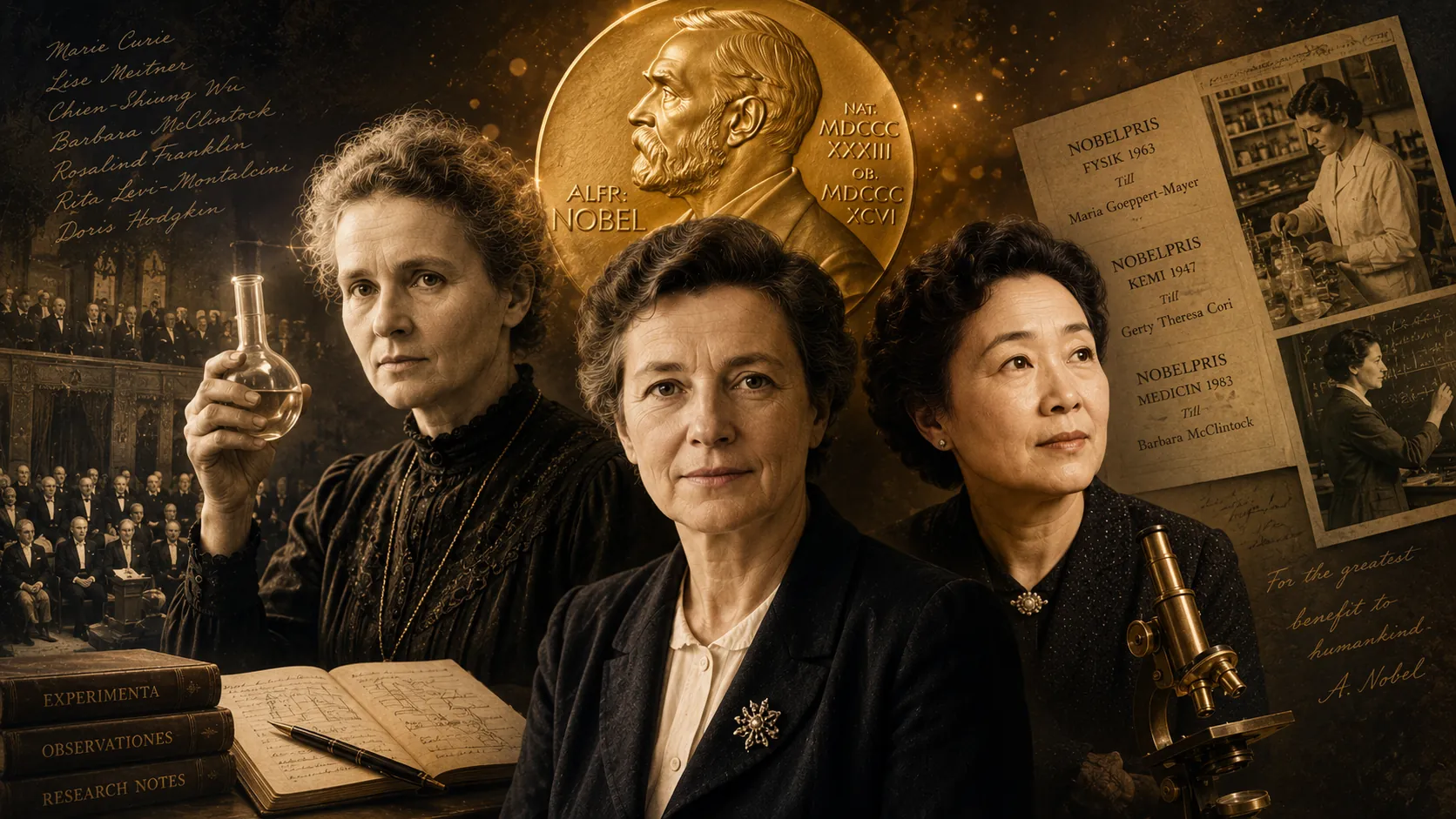
The Nobel Prize and the Women Science Forgot
The Nobel Prize can immortalise a discovery. It can also compress a complicated scientific history into a handful of names.
A Nobel Prize is excellent at creating a historical memory. A discovery acquires a year, a category and a small number of names. Science itself is not so tidy.
The Problem With Turning Collaboration Into a Prize
Modern science is collaborative, while the Nobel system asks achievement to fit a very small number of laureates. Since 1968, a Nobel Prize may be shared by no more than three people.
The rule does not uniquely disadvantage women, but it operates inside institutions that historically gave women less access to senior posts, laboratories, professional societies and the authority that makes a contribution easier to see.
Lise Meitner and the Nuclear Fission Prize
Lise Meitner worked with Otto Hahn for decades. After Nazi persecution forced her to flee Germany, Hahn and Fritz Strassmann produced experimental results that Meitner and Otto Frisch helped interpret as nuclear fission.
The 1944 Nobel Prize in Chemistry was awarded to Hahn alone. Nobel archives record 49 nominations for Meitner across Physics and Chemistry, yet she never received the prize.
Chien-Shiung Wu and the Experiment That Broke Parity
Chien-Shiung Wu carried out the decisive cobalt-60 experiment showing that parity was violated in weak interactions. Tsung-Dao Lee and Chen-Ning Yang received the 1957 Nobel Prize in Physics for the theoretical work. Wu did not.
Theory had asked the question. Experiment had forced nature to answer it. The prize remembered only part of that exchange.
Rosalind Franklin and the Prize She Could Not Receive
Rosalind Franklin died in 1958, four years before James Watson, Francis Crick and Maurice Wilkins received the 1962 Nobel Prize in Physiology or Medicine.
The explicit Nobel rule barring posthumous awards was formalised in 1974. Earlier practice generally avoided them, although exceptional cases included Erik Axel Karlfeldt in 1931 and Dag Hammarskjöld in 1961. Franklin therefore should not be explained simply by quoting a later rule backwards in time.
Jocelyn Bell Burnell and the Pulsars
As a graduate student, Jocelyn Bell Burnell noticed the unusual radio signal that led to the discovery of pulsars. The 1974 Physics prize recognised Antony Hewish and Martin Ryle, but not Bell Burnell.
The episode shows how authorship, seniority and institutional position influence whose name becomes attached to a discovery.
When the Nobel Did Recognise the Woman
The history is not only one of omission. Marie Curie, Gerty Cori, Dorothy Crowfoot Hodgkin, Barbara McClintock, Elizabeth Blackburn, Carol Greider, May-Britt Moser, Donna Strickland, Andrea Ghez, Emmanuelle Charpentier, Jennifer Doudna and Katalin Karikó are among the women whose science the Nobel committees did recognise.
Those prizes matter. They establish public memory and make it harder for a contribution to disappear.
The Barriers Before Stockholm
For much of Nobel history, women did not enter science on equal institutional terms. Universities restricted admission or appointments; access to laboratories, professional networks, grants and senior titles was unequal.
A prize can only judge the scientific landscape that institutions have already helped create.
The Memory Problem
The Nobel Prize is not a complete record of scientific importance. Some achievements involve more people than its rules permit; some researchers die before recognition arrives; some contributions become obvious only decades later.
The problem begins when the prize list is mistaken for the history of science itself. A medal is an ending. Discovery is a process.
What a Medal Cannot Tell Us
Lise Meitner, Chien-Shiung Wu, Rosalind Franklin and Jocelyn Bell Burnell do not need imaginary medals for their work to matter. Their science has to be evaluated on the evidence of what they actually did.
The Nobel Prize gives us a beautifully concise record of whom science chose to celebrate. History has the less tidy job of remembering everyone else.