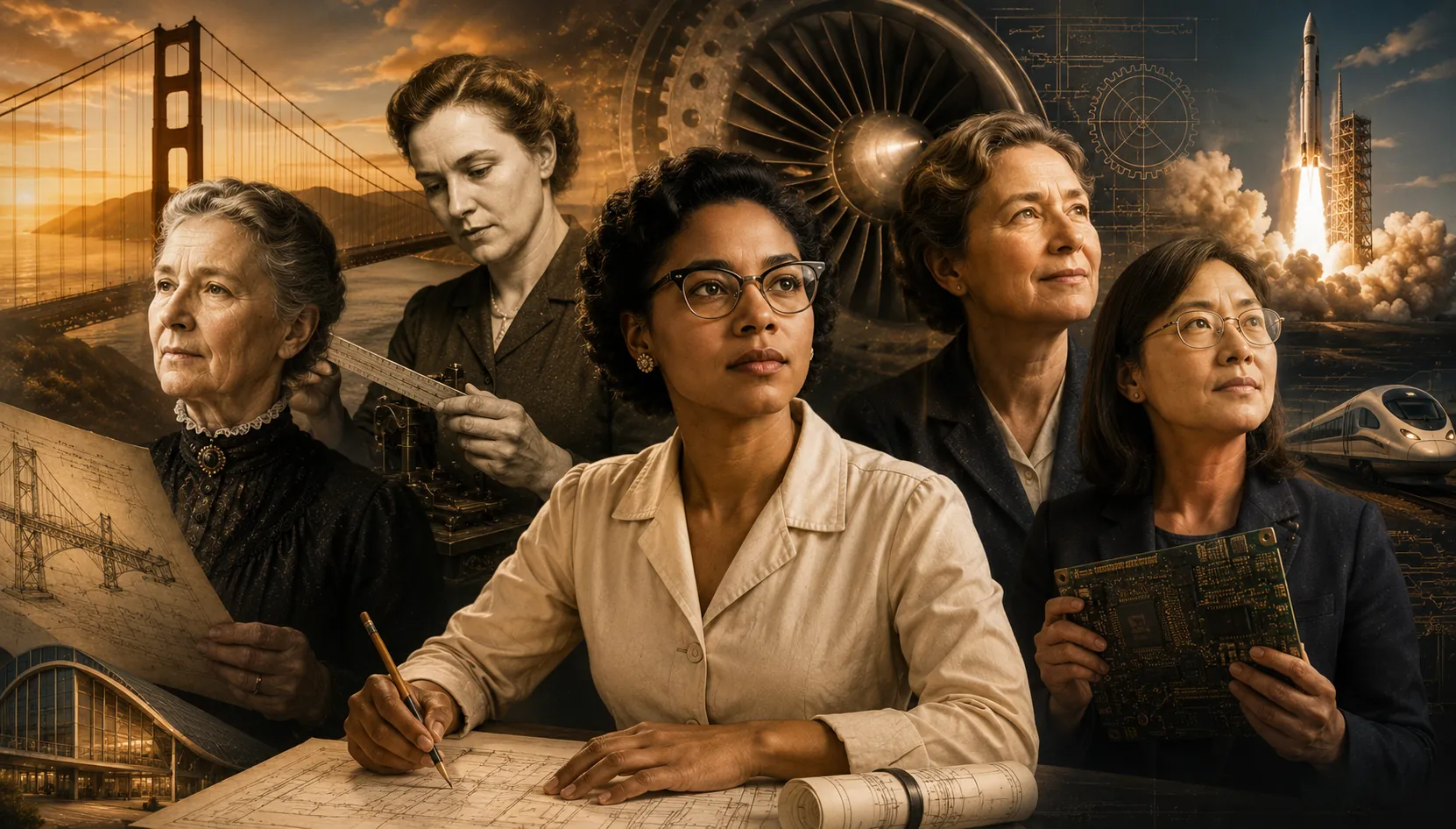
Women Engineers Who Built the Modern World
The bridges, machines, networks and systems that became ordinary life were built through generations of engineering — and women were part of that work.
Engineering is what happens after an idea meets reality.
A bridge must carry weight. An aircraft must remain stable. An electrical grid must survive demand. A material has to behave outside the laboratory. Software has to keep working when a computer is overloaded.
The modern world is full of systems that became ordinary precisely because engineers made them reliable. Women were part of that work long before engineering institutions became comfortable admitting them.
1. Emily Warren Roebling and the Bridge That Had to Be Finished
When Washington Roebling became seriously ill during construction of the Brooklyn Bridge, Emily Warren Roebling became the crucial link between the chief engineer and the work on site. She developed substantial technical knowledge, communicated instructions and helped sustain the project through years of difficulty.
2. Lillian Moller Gilbreth and Engineering Human Movement
Lillian Moller Gilbreth treated wasted motion as an engineering problem. Her work helped develop ideas now associated with ergonomics and human-centred design, in factories and homes and in adaptations for people using wheelchairs or crutches.
3. Elsie Eaves and the Engineering of Information
Civil engineer Elsie Eaves developed methods of collecting and analysing information about construction activity and expenditure. Her career is a reminder that infrastructure also depends on planning, measurement and forecasting.
4. Elsie MacGill and the Aircraft Factory
Elsie MacGill became the first woman to earn a master’s degree in aeronautical engineering and the first practising woman aircraft designer in Canada. During the Second World War she oversaw engineering work connected with mass production of Hawker Hurricane aircraft.
5. Mary Golda Ross and Engineering Beyond Earth
Mary Golda Ross worked at Lockheed on advanced aerospace problems involving trajectories, orbital mechanics and concepts for interplanetary travel — the mathematical territory where possible missions first become engineering problems.
6. Edith Clarke and the Mathematics of the Electrical Grid
Edith Clarke developed graphical and mathematical methods that made difficult power-system calculations more manageable, helping engineers analyse increasingly complex electrical networks.
7. Stephanie Kwolek and the Fibre Stronger Than It Looked
At DuPont, Stephanie Kwolek produced an unusual liquid-crystalline polymer solution and persisted in testing it. The resulting aramid fibres led to Kevlar, a material whose strength, lightness and heat resistance expanded what engineers could build.
8. Esther Conwell and the Semiconductor Problem
Esther Conwell helped explain charge transport in semiconductors, including how electrons are scattered by ionised impurities introduced through doping. Understanding impurity scattering, temperature and carrier mobility helped engineers control semiconductor behaviour more intelligently.
9. Radia Perlman and the Network That Could Not Go in Circles
Radia Perlman developed the spanning tree protocol, allowing network bridges to establish a loop-free logical structure while retaining redundant physical connections. It helped make large Ethernet networks more robust.
10. Margaret Hamilton and Software That Had to Fail Safely
Margaret Hamilton led the Apollo Guidance Computer software engineering effort at MIT's Instrumentation Laboratory.
During Apollo 11's descent, 1201 and 1202 alarms appeared as rendezvous-radar-related processing consumed computer cycles. The important engineering achievement was already in the software: priority scheduling and restart protection allowed lower-priority work to be dropped while essential guidance tasks continued.
That is fault-tolerant engineering: designing a system in advance to survive a class of failure rather than merely hoping one will not occur.
11. Engineering Institutions Had to Change Too
Women entered engineering while professional recognition remained restricted. Institutions such as Britain's Institution of Civil Engineers and American engineering societies were for decades overwhelmingly male, with women's formal access and participation expanding only gradually.
The precise rules differed by institution and period; the history should not be flattened into the claim that every society simply banned every woman. The larger pattern was unequal access to credentials, meetings, publications and professional networks.
12. The Modern World Is a System
A heroic history of engineering prefers objects: the Brooklyn Bridge, the Hurricane, the electrical grid, Kevlar, Apollo, the computer network. But engineering is rarely contained inside the object.
It is the calculation that predicts whether it will work, the manufacturing system that reproduces it, the material that makes it possible, the protocol that prevents failure and the human-centred redesign that makes it usable.
What Engineers Actually Build
There is no need to replace one heroic mythology with another. These women solved particular, difficult problems inside systems too complicated for any one person to own.
That is how the modern world was actually built: cumulatively, collaboratively and often invisibly.
The bridge stands. The grid carries power. The network routes around failure. The software decides what matters most. When engineering succeeds, the world simply works.