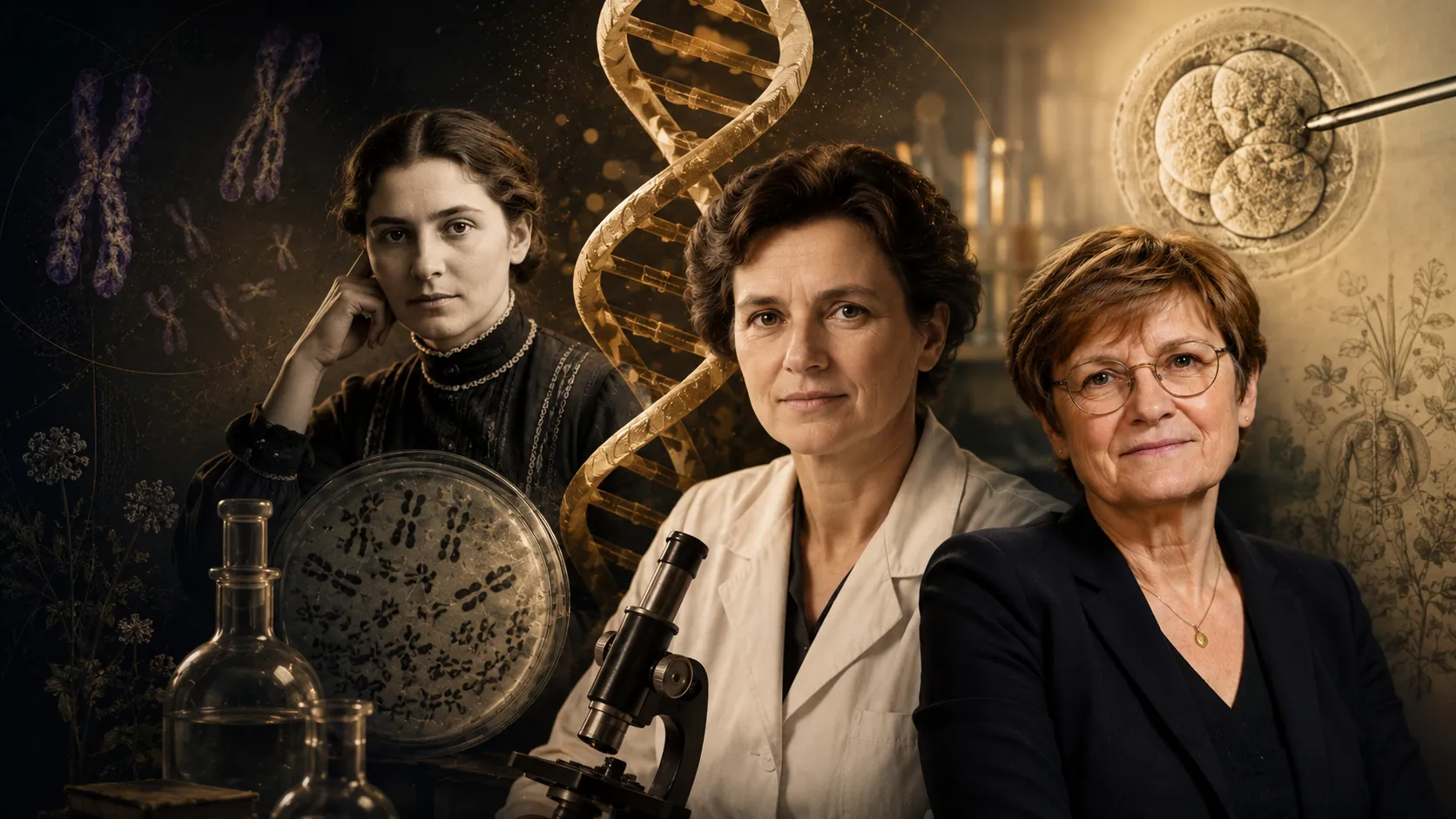
The Women Behind the Science of DNA, Genes and the Human Body
From chromosomes and DNA structure to embryos, cancer genes, genome editing and mRNA, these women helped reveal how biological information becomes a human body.
The human body is very good at concealing its instructions.
Modern biology moved steadily inward: from cells to chromosomes, from chromosomes to genes, from genes to DNA, and from DNA to the molecular systems that switch genes on, repair them, move them, edit them and turn them into living tissue.
Women helped drive that movement at almost every stage.
Life is not built by a single discovery. It is understood through many discoveries, connected across generations.
Before We Could Read the Code
Nettie Stevens and the Chromosomes That Revealed Biological Sex
In 1905, Nettie Stevens studied mealworms and found strong evidence that sex determination could be traced to particular chromosomes. Her work helped establish chromosomes as central actors in inheritance.
Gerty Cori and the Chemistry That Keeps the Body Running
Gerty Cori studied how the body stores and releases energy. The Cori cycle connected biochemistry to the ordinary fact of a body needing fuel, and in 1947 she became the first woman awarded the Nobel Prize in Physiology or Medicine.
Seeing the Molecular Machinery
Rosalind Franklin and the Evidence Inside DNA
At King's College London, Rosalind Franklin used X-ray diffraction to investigate DNA fibres. Her precise experimental work produced evidence about the molecule's dimensions, symmetry and helical character.
Franklin's importance is diminished, not strengthened, when the history is reduced to a single photograph. She was an accomplished physical chemist whose experimental analysis helped constrain what a correct model of DNA could be.
Dorothy Crowfoot Hodgkin and the Architecture of Biological Molecules
Dorothy Crowfoot Hodgkin used X-ray crystallography to determine the structures of biologically important compounds including penicillin, vitamin B12 and insulin. Her work helped make the invisible architecture of life visible enough to understand.
The Genome Becomes Stranger
Barbara McClintock and the Genes That Moved
Barbara McClintock discovered genetic elements capable of changing position and altering the activity of nearby genes. Today they are known as transposable elements. The genome was not the fixed instruction manual many had imagined.
Elizabeth Shull Russell and the Genetics of Development
Elizabeth Shull Russell used mouse genetics to investigate how inherited mutations affect development, blood formation, pigmentation and reproduction. Her work helped connect genes to cell proliferation, migration, differentiation and survival.
Russell is best understood as an important bridge in developmental genetics, rather than as a direct precursor of every later stem-cell technology.
How Genes Become a Body
Anne McLaren and the Embryo Outside the Body
Working with John Biggers, Anne McLaren showed that early mouse embryos could develop in culture and later continue normal development after transfer into a uterus.
McLaren did not invent IVF. Her experimental embryology helped establish part of the scientific foundation on which reproductive medicine later built.
A gene is not a body. Development is the process that turns inherited information into cells, tissues and an organism.
Molecular Biology Meets Disease
Françoise Barré-Sinoussi and the Virus Behind AIDS
Françoise Barré-Sinoussi and colleagues at the Pasteur Institute isolated a retrovirus from a patient with lymphadenopathy. The work became central to identifying HIV as the cause of AIDS.
Elizabeth Blackburn, Carol Greider and the Ends of Chromosomes
Elizabeth Blackburn and Carol Greider helped uncover telomerase, the enzyme that extends telomeres at chromosome ends. Their work transformed understanding of chromosome maintenance, cellular lifespan, ageing and cancer.
Mary-Claire King and the Inherited Risk of Breast Cancer
Mary-Claire King showed that inherited susceptibility to breast cancer could be mapped genetically. In 1990 her group located a major susceptibility locus on chromosome 17; the gene later identified there became known as BRCA1.
From Reading Biology to Rewriting It
Jennifer Doudna, Emmanuelle Charpentier and Programmable DNA Editing
Jennifer Doudna and Emmanuelle Charpentier helped demonstrate how CRISPR-Cas9 could be engineered into a programmable system for cutting DNA at chosen sequences, making genome editing dramatically easier.
Katalin Karikó and the Message That Became Medicine
Working with Drew Weissman, Katalin Karikó showed that incorporating modified nucleosides, including pseudouridine, could reduce innate immune recognition of synthetic mRNA, including activation through Toll-like receptors.
That foundational work helped make mRNA far more useful therapeutically and contributed to the science behind the mRNA vaccine platforms used during the COVID-19 pandemic.
Biology's great transition was from observing inheritance, to reading its molecular language, to gaining the ability to alter that language deliberately.
The Instructions Were Never the Whole Story
There is no single moment at which humanity discovered how the body works. These discoveries form a chain across generations, but not a predetermined one. Each scientist was solving the problem in front of her.
The human body did not yield its secrets in one revelation. It yielded them piece by piece, as researchers learned to see deeper into the machinery of life.