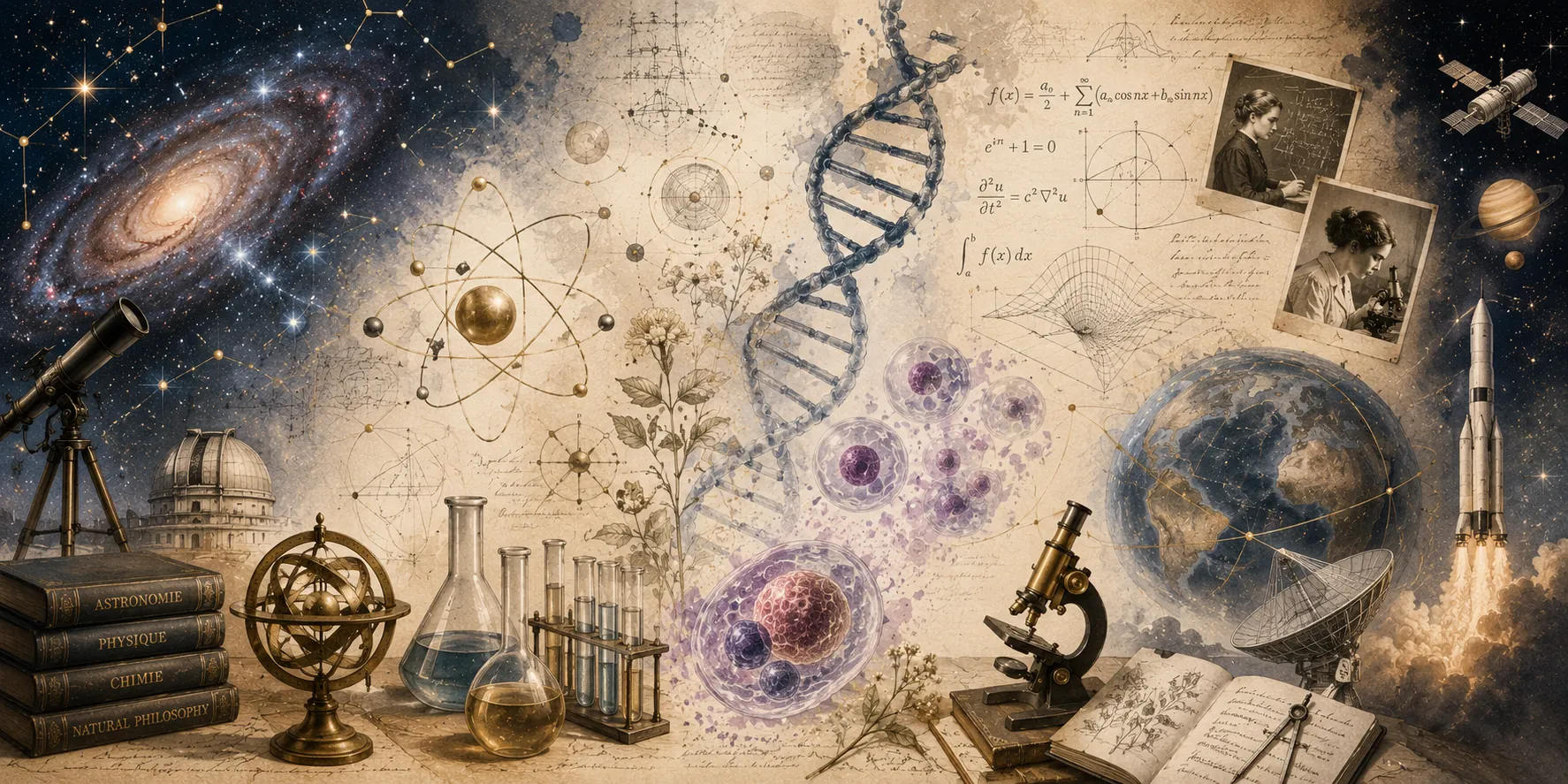
15 Women Scientists Who Changed How We Understand the World
Fifteen scientists, fifteen ideas, and a journey through the discoveries that changed how we understand matter, stars, genes, medicine and the universe.
Science has a habit of making yesterday's certainties look slightly embarrassing.
Stars turn out not to be made of what everybody thought. Matter behaves according to symmetries hidden inside mathematics. Genes move. Galaxies rotate too quickly. A molecule once treated as an inconvenient laboratory curiosity becomes the basis of a vaccine technology used around the world.
Then, after enough time has passed, the new explanation becomes so familiar that it is difficult to remember there was ever anything to explain.
The history of science is full of these moments: an observation that doesn't fit, an experiment that refuses to behave, a calculation that suggests the universe is stranger than expected.
Women were present for many of them.
Sometimes they received the prizes. Sometimes somebody else did. Sometimes their work was recognised immediately; sometimes the scientific world required a few decades to reconsider its opinion.
And the obstacles were not merely matters of individual prejudice. For long stretches of scientific history, women were excluded from universities, denied ordinary academic appointments, kept out of laboratories or professional societies, and given less access to the money, equipment and institutional authority on which experimental science increasingly depended. Talent could survive those conditions. It should not be mistaken for evidence that the conditions did no damage.
What follows, then, is not a list of fifteen women who each single-handedly "changed the world." Science rarely works that way.
It is a journey through fifteen ideas that changed how we understand it.
Imagining Machines, Matter and Mathematical Laws
Before scientists could manipulate genes or travel beyond Earth, they first had to rethink some rather fundamental things: what machines might be capable of, what matter was made of and whether mathematics could reveal laws hiding underneath physical reality.
1. Ada Lovelace and the Machine That Might Do More Than Calculate
Ada Lovelace lived before a working general-purpose computer existed.
This was inconvenient in practical terms, but apparently not fatal to the imagination.
In the 1840s, Lovelace studied Charles Babbage's plans for the Analytical Engine, a mechanical calculating machine far more ambitious than anything then in use. While translating an Italian account of the machine, she added a set of notes considerably longer than the original paper.
One of them described a method by which the Engine could calculate Bernoulli numbers.
It is the reason Lovelace is frequently described as the first computer programmer.
As with most tidy historical titles, the reality is more interesting.
Babbage had already developed procedures for his machines, and historians continue to debate precisely how "first programmer" should be understood. Lovelace's importance does not depend on winning the title.
What distinguished her thinking was the breadth of what she imagined.
She recognised that a machine capable of manipulating symbols according to rules need not be confined to arithmetic. If music, language or other information could somehow be represented in a form the machine could process, the machine might operate on those things too.
The computer had not yet been built, and Lovelace was already wondering what it might become.
That is not the same as inventing the computer.
It may be more interesting.
The larger idea: Lovelace was thinking beyond calculation toward the possibility of a general-purpose machine manipulating many kinds of information.
2. Marie Curie and the Matter That Wouldn't Stay Still
At the end of the nineteenth century, the atom was still supposed to be reassuringly solid.
Marie Curie's work helped make it considerably less reassuring.
After Henri Becquerel discovered unusual radiation coming from uranium salts, Curie began investigating the phenomenon systematically. She found that the radiation was linked to the atoms themselves rather than to their chemical arrangement.
She gave the phenomenon a name: radioactivity.
Working with Pierre Curie, she investigated ores that appeared more radioactive than uranium alone could explain. The work ultimately led to the identification of two new elements, polonium and radium.
It was punishing laboratory work carried out under conditions that would horrify a modern radiation-safety officer.
The scientific consequences were enormous.
Radioactivity helped overturn older ideas about atoms as indivisible, unchanging units of matter. It contributed to the emergence of nuclear physics and eventually to technologies ranging from radiotherapy to nuclear power.
Curie became the first woman to receive a Nobel Prize and remains the only person awarded Nobels in two different scientific fields: physics and chemistry.
But the prizes can obscure what was genuinely destabilising about the science.
Matter itself was changing.
The atom, once regarded as the end of the story, had become the beginning of another one.
3. Emmy Noether and the Mathematics Hiding Inside Physics
Some scientific revolutions arrive with dramatic experiments.
Emmy Noether's arrived in equations.
In the early twentieth century, physics was being rebuilt. Einstein's theories of relativity had altered ideas about space, time and gravity, and physicists were wrestling with the mathematical consequences.
Noether entered this world as one of the most formidable mathematicians of her generation.
Her most famous result, now known as Noether's theorem, revealed a deep connection between symmetry and conservation laws.
The principle is startlingly elegant.
When the laws governing a physical system remain unchanged under a particular kind of transformation, there is a corresponding quantity that is conserved.
If the laws of physics do not change over time, energy is conserved. If they do not depend on where an experiment takes place, momentum is conserved. Rotational symmetry is connected to the conservation of angular momentum.
Put rather less mathematically:
Same laws through time → conservation of energy
Same laws from place to place → conservation of momentum
Same laws under rotation → conservation of angular momentum
Two ideas that might appear separate — symmetry and conservation — turn out to be different faces of the same structure.
Modern theoretical physics is saturated with this way of thinking.
Noether's work became fundamental to fields she never lived to see fully develop, including modern particle physics.
Her professional circumstances were rather less elegant.
For much of her early career, German universities did not permit women to hold ordinary academic positions. She taught for years through insecure arrangements and at times under the name of male colleagues.
The equations were more progressive than the institution.
Reading the Stars and Splitting the Atom
During the first half of the twentieth century, the scale of scientific inquiry expanded in two directions at once.
Scientists were learning what enormous stars were made of while simultaneously prising open the atomic nucleus.
Both turned out to be stranger than expected.
4. Cecilia Payne-Gaposchkin and What the Stars Are Made Of
The Sun looks substantial.
It seems reasonable, therefore, that early astronomers assumed its composition might broadly resemble that of the Earth.
Cecilia Payne had other ideas.
In the 1920s, she analysed the spectra of stars — the patterns produced when their light is separated into different wavelengths. These patterns contain information about which elements are present and under what conditions.
Her doctoral research led to a striking conclusion.
Hydrogen and helium were vastly more abundant in stars than elements such as iron and silicon.
This contradicted prevailing expectations.
The result was so surprising that Payne was persuaded to present the conclusion cautiously. Within a few years, other astronomers reached the same answer.
The stars were, after all, mostly hydrogen and helium.
Today the fact is so basic that it appears in introductory astronomy textbooks.
That makes it easy to miss how radical the conclusion once was.
Payne did not discover an obscure detail about a particular class of star.
She helped establish what most of the visible universe is made of.
5. Lise Meitner and the Atom That Split
Nuclear fission entered history with consequences so enormous that it can be difficult to return to the original scientific puzzle.
The puzzle began with uranium.
In the late 1930s, physicists were bombarding uranium atoms with neutrons and examining the products. Otto Hahn and Fritz Strassmann obtained results that did not make obvious sense: lighter elements appeared to be emerging from uranium.
Hahn turned to Lise Meitner.
Meitner, an Austrian-born physicist who had worked with Hahn for decades, had been forced to flee Nazi Germany because of her Jewish ancestry.
In exile in Sweden, she and her nephew Otto Frisch worked through the physics.
The uranium nucleus, they realised, was splitting.
They explained the process theoretically and recognised that a small amount of mass would be converted into a very large amount of energy, consistent with Einstein's relation between mass and energy.
Frisch gave the process its name: fission.
The discovery transformed nuclear physics and soon became entangled with the development of nuclear weapons and, later, nuclear power.
In 1944, the Nobel Prize in Chemistry was awarded to Otto Hahn alone for the discovery of nuclear fission.
Meitner's exclusion has become one of the most discussed recognition disputes in twentieth-century science.
The important point is not that Hahn did nothing — he performed crucial experimental work.
It is that the scientific achievement was larger and more collaborative than the prize suggested.
Meitner's forced exile adds another dimension. Scientific exclusion did not merely determine who received a title or a laboratory. Political persecution could sever collaborations, remove researchers from equipment and institutions, and alter the conditions under which discoveries were made.
The nucleus had split.
So, rather awkwardly, had the credit.
6. Chien-Shiung Wu and the Experiment That Physics Didn't Expect
Physicists like symmetry.
Nature, less reliably, does.
By the 1950s, physicists generally assumed that the laws governing certain subatomic processes behaved identically in a mirror-reflected universe. This idea was known as parity conservation.
The assumption was elegant.
There was just one problem: nobody had actually tested it in the relevant weak nuclear interactions.
Theoretical physicists Tsung-Dao Lee and Chen-Ning Yang questioned whether parity necessarily had to be conserved and proposed experiments to find out.
Chien-Shiung Wu performed the crucial one.
Working with colleagues at the National Bureau of Standards, Wu studied the radioactive decay of cobalt-60 atoms at extremely low temperatures.
The result was unmistakable.
Nature distinguished left from right.
Parity was violated.
One of the supposedly fundamental symmetries of physics did not hold in weak interactions.
Lee and Yang received the 1957 Nobel Prize in Physics for the theoretical work.
Wu did not.
There are scientific results that add a new fact to what we know.
Wu's experiment did something more unsettling.
It proved that physicists had mistaken aesthetic preference for physical law.
The universe was under no obligation to be as symmetrical as they hoped.
What changed? Before Wu's experiment, parity was widely treated as a fundamental symmetry. Afterwards, physicists had to accept that nature itself could distinguish left from right.
Decoding the Machinery of Life
Physics had split the atom. Biology was about to make its own unsettling discoveries.
DNA had a structure. Genes did not always stay put. Biological molecules could be mapped atom by atom. And the behaviour of an embryo outside the body would eventually acquire consequences far beyond the laboratory.
7. Rosalind Franklin and the Evidence Inside DNA
The double helix has become such a familiar scientific image that it almost looks inevitable.
It wasn't.
In the early 1950s, researchers were racing to understand the structure of DNA. At King's College London, Rosalind Franklin used X-ray diffraction to investigate DNA fibres.
The technique does not produce a photograph of a molecule in any ordinary sense.
Instead, X-rays scatter as they pass through an ordered sample, creating patterns from which aspects of molecular structure can be inferred.
Franklin was exceptionally skilled at producing and interpreting such data.
One diffraction image, famously known as Photograph 51, contained striking evidence of DNA's helical structure.
James Watson and Francis Crick eventually proposed the correct double-helix model in 1953, drawing on multiple sources of evidence, including experimental information produced by Franklin and Maurice Wilkins's group.
Franklin died in 1958, aged thirty-seven.
When the Nobel Prize in Physiology or Medicine was awarded to Watson, Crick and Wilkins in 1962, Nobel rules did not permit posthumous awards.
The story has since become a case study in scientific credit, sometimes simplified until Franklin is presented either as the sole discoverer of DNA's structure or as a passive victim whose data did all the work for others.
Neither account does justice to the science.
Franklin was an accomplished experimentalist whose evidence was essential to understanding DNA's structure.
The molecule did not reveal itself to a single person.
Science rarely does.
8. Barbara McClintock and the Genes That Refused to Stay Put
Genes were supposed to stay where they were put.
Barbara McClintock found some that didn't.
Studying maize in the 1940s and 1950s, McClintock investigated chromosomes and patterns of inheritance. She noticed genetic elements capable of moving from one position in the genome to another and affecting the activity of nearby genes.
She called them controlling elements.
Today we know such mobile sequences as transposable elements, or transposons.
At the time, the idea sat awkwardly with prevailing models of the genome.
Genes were often imagined as occupying stable positions along chromosomes, behaving in an orderly linear fashion.
McClintock's maize was suggesting something considerably more dynamic.
Her findings were received with scepticism and, for years, were not fully appreciated.
Then molecular genetics caught up.
Transposable elements were discovered in other organisms and eventually recognised as widespread features of genomes.
In 1983, McClintock received the Nobel Prize in Physiology or Medicine for her discovery.
It had taken science roughly three decades to become comfortable with what her maize had been saying.
Genomes, it turned out, were not static instruction manuals.
Parts of them could move.
9. Dorothy Crowfoot Hodgkin and the Architecture of Molecules
Chemistry becomes much easier once you know what a molecule actually looks like.
The difficulty is that molecules are extremely small and tend not to pose for portraits.
Dorothy Crowfoot Hodgkin used X-ray crystallography to work out their structures.
The technique relies on firing X-rays through crystals and analysing the diffraction patterns that result. From those patterns, scientists can reconstruct the three-dimensional arrangement of atoms.
It requires mathematics, chemistry, patience and, particularly in Hodgkin's era, heroic quantities of calculation.
Hodgkin applied the method to biologically important molecules.
She determined the structure of penicillin, then vitamin B12, and later insulin after decades of work.
Knowing a molecule's structure is not merely satisfying to chemists.
Structure governs behaviour.
Understanding the precise arrangement of atoms can reveal how a biological molecule works, how a medicine interacts with the body and how new treatments might be designed.
Hodgkin received the Nobel Prize in Chemistry in 1964.
What she really spent her career doing was making the invisible geometries of life visible enough to understand.
10. Anne McLaren and the Beginnings of Life
Not every scientific advance produces an object.
Some change what medicine is capable of doing years later.
Anne McLaren studied the earliest stages of mammalian development.
Working with John Biggers in the 1950s, she investigated whether mouse embryos could develop outside the mother's body before being transferred into another uterus.
They could.
The embryos continued developing, and healthy offspring were born.
The experiments helped establish fundamental knowledge about early mammalian embryos and contributed to the scientific foundations from which reproductive technologies such as IVF would later develop.
McLaren did not invent IVF.
That distinction matters for precisely the same reason it mattered with so many inventions elsewhere in scientific history: accuracy is more interesting than an inflated claim.
Human IVF required the work of other researchers and clinicians, including Robert Edwards, Patrick Steptoe and Jean Purdy.
McLaren's contribution was more fundamental.
She helped establish what early embryos could survive and how development proceeded.
Basic science has a peculiar timetable.
The person asking the question cannot always know what the answer will eventually permit somebody else to do.
For reproductive biology, some of those answers would become extraordinarily intimate.
From Medicine to the Moon
By the middle of the twentieth century, scientific knowledge was increasingly becoming something that could be deployed: against disease, in spacecraft and through machines capable of performing calculations at unprecedented speed.
The distinction between "pure" and "applied" science was becoming harder to keep tidy.
11. Tu Youyou and the Medicine Hidden in an Ancient Text
Sometimes scientific progress involves building something entirely new.
Sometimes it involves looking again at something very old.
During the 1960s, malaria remained a major global health problem, and resistance was reducing the effectiveness of existing treatments.
Tu Youyou, a Chinese pharmaceutical chemist, was assigned to work on the search for new antimalarial drugs.
Her team examined hundreds of traditional Chinese medical preparations.
Among them was sweet wormwood, Artemisia annua, a plant mentioned in ancient medical writings.
Early extracts produced inconsistent results.
Then Tu reconsidered the preparation method.
A historical text suggested soaking the plant rather than boiling it. High temperatures, she suspected, might be destroying the active compound.
Using a lower-temperature extraction method produced a much more effective preparation.
The work ultimately led to the isolation of artemisinin, a potent antimalarial compound.
Artemisinin-based combination therapies became central to modern malaria treatment and have saved vast numbers of lives.
Tu received the Nobel Prize in Physiology or Medicine in 2015.
The achievement is sometimes framed as ancient wisdom triumphing over modern science.
It is almost the opposite.
Tu treated an old source not as unquestionable wisdom but as evidence worth testing.
Tradition provided a clue.
Experiment decided whether the clue was useful.
12. Katherine Johnson and the Mathematics Between Earth and Space
Human spaceflight tends to be remembered through machinery.
Rockets are visually persuasive.
Orbital mechanics is less so.
Katherine Johnson spent her career dealing with the part that refuses to fit easily into a photograph: the mathematics required to make sure a spacecraft went where it was supposed to go.
At NASA and its predecessor organisation, she calculated trajectories, launch windows and return paths for early American space missions.
Her work contributed to Alan Shepard's 1961 flight and John Glenn's orbital mission the following year.
Johnson's career also unfolded inside institutions shaped by both racial segregation and sex discrimination. Black women mathematicians at the organisation then known as NACA worked in segregated units, and professional advancement did not occur on equal terms. The accuracy expected from their calculations was absolute; the opportunities afforded to the people making them were not.
By the early 1960s, NASA was increasingly using electronic computers to calculate flight paths.
Glenn nevertheless asked for Johnson to verify the computer's calculations before his mission.
This detail has become famous because it makes a good story about human intelligence defeating the machine.
That is not quite what happened.
Johnson herself was an enthusiastic user of new computing technology.
The important point was confidence. Electronic computation was being introduced into an environment where mistakes could be fatal, and Johnson's mathematical judgement had earned unusual trust.
Her career sits at an interesting boundary.
She belonged to the generation that performed calculations by hand and to the generation that helped move spaceflight into the computer age.
The astronauts got the view.
Somebody still had to calculate how they would come home.
The Invisible Universe
Spaceflight allowed humans to leave Earth.
Astronomy, meanwhile, was discovering that even after looking outward for centuries, we might still have been missing most of what was there.
13. Vera Rubin and the Universe We Couldn't See
Galaxies rotate.
This much was known.
The troublesome part was how quickly.
Vera Rubin and her colleague Kent Ford measured the speeds at which stars and gas moved around spiral galaxies. According to the visible mass in those galaxies, objects farther from the centre ought to orbit more slowly.
They didn't.
The outer regions were moving far faster than expected.
Something was providing additional gravity.
Rubin's observations became some of the most influential evidence for dark matter: matter that does not emit light but appears to reveal itself through its gravitational effects.
Dark matter remains one of the great unresolved problems in physics.
We still do not know what it is.
Yet the evidence suggests that the ordinary matter making up stars, planets, people and almost everything we can see accounts for only a fraction of the universe's matter.
There is a particular elegance to Rubin's place in this history.
Astronomy had spent centuries learning to see farther.
Rubin helped demonstrate that most of the matter was apparently something we could not see at all.
One of astronomy's great reversals: better observation did not simply reveal more visible matter. It revealed that visible matter was not enough.
Rewriting Life
The last great shift is perhaps the most unsettling.
Earlier scientists learned to observe matter, stars and genes. Modern biology increasingly allows us to intervene.
The question is no longer only what life is doing.
It is what we should be permitted to do to life.
14. Jennifer Doudna and the Ability to Rewrite DNA
For most of genetics, scientists had been learning to read DNA.
CRISPR helped make editing it far easier.
Jennifer Doudna, working with Emmanuelle Charpentier and other researchers, helped establish how a bacterial defence system could be adapted into a programmable tool for cutting DNA at chosen locations.
The implications were immediate.
If scientists could direct a molecular system to a particular DNA sequence, they could potentially remove, alter or replace genetic material with far greater precision and simplicity than many earlier methods allowed.
CRISPR-Cas9 spread through biology laboratories with remarkable speed.
It opened new possibilities for studying genes, engineering organisms and developing treatments for genetic disease.
It also created questions that science cannot answer alone.
Which genetic changes should be permitted? What happens when edits can be inherited? Where is the boundary between treating disease and altering human traits?
A sufficiently powerful technology eventually stops being merely a technical question.
Doudna herself became an important public voice in debates about the responsible use of genome editing.
In 2020, she and Charpentier received the Nobel Prize in Chemistry.
By then, the question was no longer whether humans could edit genomes with unprecedented ease.
It was what we intended to do with that ability.
15. Katalin Karikó and the Molecule That Took Decades to Matter
Messenger RNA is temporary by design.
It carries genetic instructions from DNA to the cellular machinery that makes proteins, does its job and disappears.
For years, Katalin Karikó believed this short-lived molecule could also be useful as a medical technology.
The idea had problems.
Synthetic mRNA could provoke damaging immune reactions. It was unstable. Funding was difficult. Karikó was demoted at the University of Pennsylvania after repeatedly failing to secure research grants.
She continued anyway.
Working with immunologist Drew Weissman, Karikó helped discover that modifying certain components of synthetic mRNA could dramatically reduce unwanted inflammatory responses.
The advance helped make therapeutic uses of mRNA much more practical.
For years, the work remained important largely within a specialised scientific community.
Then came COVID-19.
The mRNA vaccine platforms developed by BioNTech-Pfizer and Moderna demonstrated on an enormous scale what decades of foundational research had made possible.
Karikó and Weissman received the 2023 Nobel Prize in Physiology or Medicine for discoveries that enabled effective mRNA vaccines against COVID-19.
It is tempting to tell this story as a morality tale about persistence.
That would be convenient, and only partly true.
Persistence matters. So do institutions, funding, colleagues, accidents of timing and whether a scientific idea happens to encounter the historical moment in which the world suddenly needs it.
Karikó's career is a useful reminder that scientific systems do not merely reward good ideas after judging them perfectly. They decide which work receives money, laboratory space, job security and time. Sometimes they judge correctly. Sometimes a scientist spends years working on something the institution has decided is unlikely to matter.
Karikó could not have predicted a pandemic decades in advance.
She simply kept asking what RNA might be capable of.
The world eventually supplied an answer.
The World After the Question
There is a tendency to describe scientists as people who produce answers.
The more interesting ones often produce better questions.
Could a machine manipulate symbols rather than merely numbers?
What are stars actually made of?
Does nature really respect left and right?
Can genes move?
Why are galaxies rotating too quickly?
Can an embryo continue developing outside the body?
Can RNA become medicine?
Each question unsettled something that had seemed reasonably settled beforehand.
That is what connects these fifteen women more than any shared category of "female scientist."
Their work spans mathematics, astronomy, physics, chemistry, genetics, medicine and computing. Some worked alone for stretches; others belonged to teams. Some became famous. Some spent years watching colleagues receive more recognition than they did. Some were believed immediately; others had the peculiar experience of being correct before their field was ready to agree.
And the barriers they encountered were not identical.
Noether faced universities that did not consider women ordinary academic citizens. Meitner's career was ruptured by Nazi persecution. Johnson worked within segregated American institutions. Karikó encountered a modern scientific system in which access depended increasingly on grants, institutional status and whether other people considered a research direction worth financing.
Scientific exclusion changes with the century.
It does not always disappear.
Nor do their discoveries all fit the comfortable language of "changing the world."
Emmy Noether did not invent a household object. Cecilia Payne-Gaposchkin did not create a new machine. Vera Rubin did not solve dark matter.
They changed the framework through which everybody after them had to think.
That may be the more lasting kind of change.
Once you know that stars are mostly hydrogen and helium, you cannot return to the older universe. Once parity has failed, physics has to live with the asymmetry. Once genes can move, the genome stops looking fixed. Once the visible matter in galaxies can no longer explain their motion, much of the universe becomes a question mark.
Scientific knowledge accumulates, but it does not merely pile up.
Occasionally it rearranges the room.
These women helped move the furniture.
Continue exploring
Explore Scientists to discover more women whose work changed physics, medicine, computing, engineering, mathematics and our understanding of the universe.
Browse Discoveries to follow the experiments, theories and technologies behind the science.
Or continue through the Timeline to see how these breakthroughs connect across generations — from the first ideas about programmable machines to genome editing and mRNA.