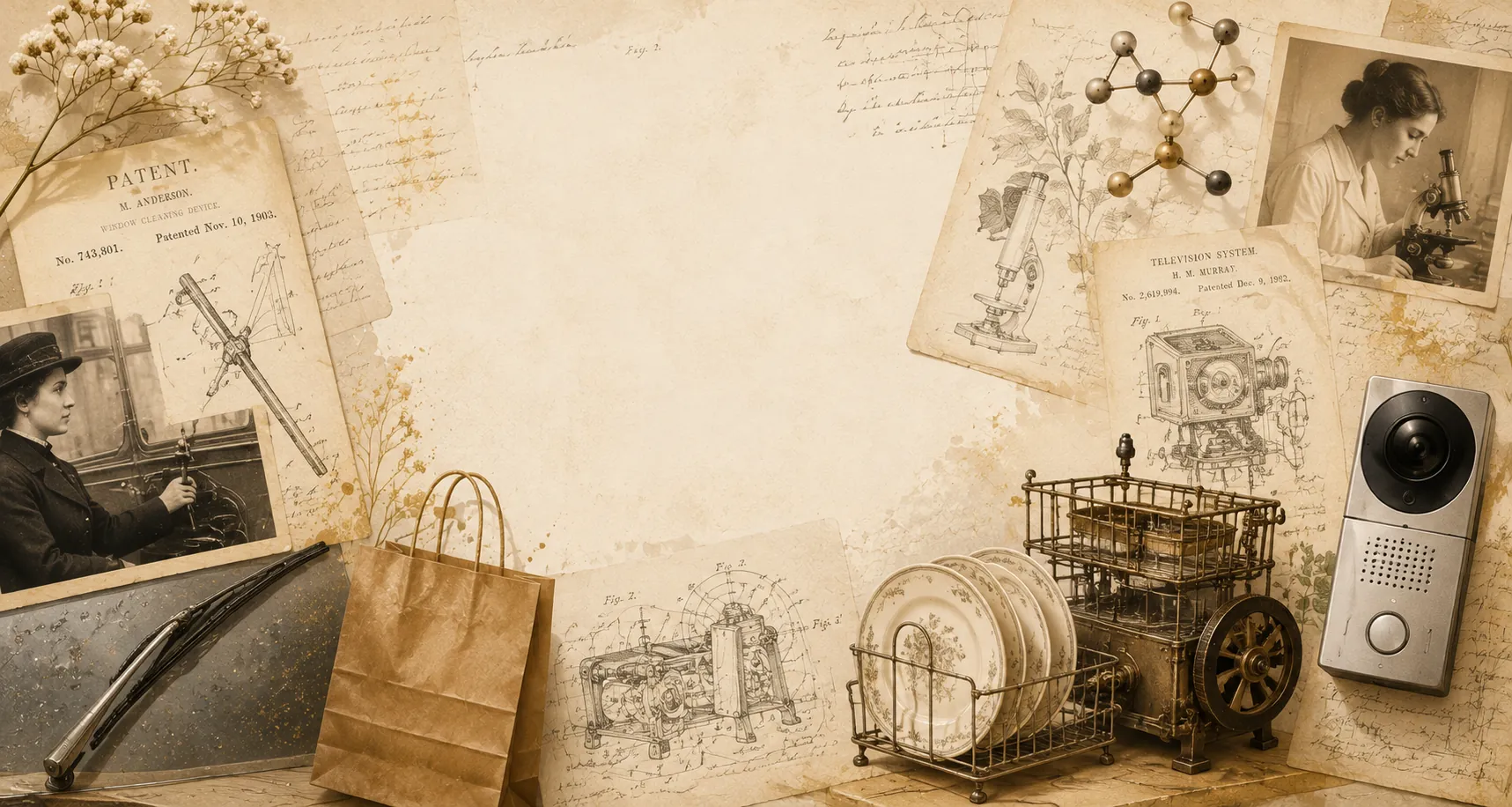
10 Inventions by Women That Changed Everyday Life
From windscreen wipers and dishwashers to Kevlar, home security and IVF, these stories show how women helped shape technologies that became part of ordinary life.
There is a peculiar thing about inventions once they become useful enough: we stop noticing them.
Nobody gets into a car on a wet Tuesday morning and gives much thought to the person who decided drivers ought to be able to clear rain from the windscreen without opening the window. We load the dishwasher, carry groceries home in paper bags, answer the door through a camera, and make a telephone call expecting that somebody, somewhere, made sure it would connect.
The objects work. That is generally enough for us.
Their histories are less cooperative.
The things we use every day tend not to have been invented in the neat manner suggested by schoolbooks. There is rarely a solitary genius, a sudden flash and — presto — the modern world. There are earlier versions, competing patents, collaborators, improvements, abandoned experiments and ideas that arrive before anybody knows quite what to do with them.
And scattered throughout these histories are women whose names have somehow become considerably less familiar than the things they helped create.
1. Mary Anderson and the Windscreen Wiper
The problem Mary Anderson noticed was not exactly difficult to see.
It was a sleeting winter in New York, and the driver of Anderson's streetcar was struggling to see through the front glass. To clear it, drivers had to crack open a window, lean outside, or stop the vehicle entirely.
Anderson thought there ought to be a better way.
In 1903 she received a patent for a window-cleaning device: a rubber blade attached to an arm that could be operated by the driver from inside the vehicle.
It sounds obvious now, which is one of the occupational hazards of successful invention. Once somebody has solved a problem elegantly enough, the solution acquires an air of inevitability. Of course cars have windscreen wipers. What else could they possibly have?
The commercial world was less convinced.
Anderson tried to sell the rights to her invention, but the company she approached saw little commercial value in it. Her patent eventually expired while the cars, meanwhile, kept coming.
By the 1920s, windscreen wipers were becoming standard equipment on automobiles. Anderson had identified a problem that would soon confront millions of drivers; she had simply done so before the automobile industry quite appreciated how large it was going to become.
She did not become rich from the invention.
We did, however, get the wiper.
2. Josephine Cochrane and the Dishwasher
Josephine Cochrane did not invent mechanical dishwashing. This distinction matters: the history of invention is full of perfectly good stories ruined by an unnecessary claim to being first.
Machines for washing dishes had been attempted before Cochrane began working on hers.
The trouble was that they weren't particularly good.
Cochrane wanted something practical: a machine that could clean dishes efficiently without chipping them. Her solution held crockery securely in wire compartments while jets of hot, pressurised water did the washing.
She patented her design in 1886.
At first, the machine was not destined for the ordinary domestic kitchen. It was expensive and particularly attractive to places with formidable quantities of washing-up — hotels and restaurants. Cochrane exhibited it at the World's Columbian Exposition in Chicago in 1893, and commercial orders followed.
The household dishwasher took much longer to become ordinary, which is worth remembering. We tend to compress invention into dates: 1886, dishwasher invented. But an invention and its arrival in everyday life can be separated by decades.
Cochrane solved the engineering problem; society still had to catch up.
3. Margaret E. Knight and the Paper Bag
A paper bag is not an object that encourages philosophical reflection.
Perhaps it should.
For much of the nineteenth century, commercially produced paper bags were rather more envelope-like than the grocery bags we recognise today. Margaret E. Knight devised machinery that could cut, fold and paste paper into bags with flat bottoms.
Flat bottoms are not glamorous.
They are, however, extremely useful when you need a bag to stand upright while loading groceries into it.
Knight's machine turned that simple advantage into something that could be manufactured efficiently. Then came the patent fight.
While Knight was developing her machine, Charles Annan attempted to claim the invention. Knight challenged him and produced drawings, notes and other evidence demonstrating how she had developed the machinery.
She won, receiving her patent in 1871 and continuing to invent for decades afterwards.
The basic concept survived. Machinery based on Knight's idea continued to be used to manufacture the flat-bottomed paper grocery bag — an object so ordinary that its engineering has effectively disappeared from view.
There is something pleasingly disproportionate about the whole story: a serious mechanical mind, years of experimentation and a patent dispute, all in service of an object we now crumple up without thinking.
4. Katharine Burr Blodgett and the Glass That Almost Disappeared
Katharine Burr Blodgett worked on things too thin to see.
At General Electric, alongside physicist Irving Langmuir, she studied films just one molecule thick and developed methods for depositing these films layer upon layer.
The work demanded an extraordinary degree of control. Add the right number of molecular layers to a piece of glass and something interesting happens: reflection can be dramatically reduced.
Blodgett demonstrated non-reflecting glass in 1938.
Ordinary glass reflects some of the light that strikes it. Blodgett's coatings could interfere with those reflected light waves, producing glass that appeared almost to vanish.
This was not merely an elegant laboratory trick. The principles behind such coatings became important in optics, including lenses and other precision instruments, while the techniques developed for manipulating molecular films became significant in their own right.
The story is a useful reminder of how misleading the word invention can be. There was no household object waiting to be assembled. There was painstaking research into the behaviour of matter at a scale no human eye could observe, followed by the discovery that invisible architecture could change the visible world.
5. Hedy Lamarr and the Signal That Wouldn't Stay Put
Hedy Lamarr presents historians with a peculiar problem.
Her real story is remarkable enough, yet the embellished version has proved almost irresistible.
Lamarr was one of Hollywood's most famous actresses when, during the Second World War, she began working with composer George Antheil on a problem involving radio-controlled torpedoes.
A radio signal transmitted on a fixed frequency could be jammed. So why stay on one frequency?
Lamarr and Antheil devised a communication system in which transmitter and receiver would move together through different frequencies. They received a US patent for their frequency-hopping system in 1942.
Then very little happened.
Their particular system was not adopted as the wartime breakthrough they had hoped for, and its subsequent history is considerably more complicated than the internet usually allows.
This has not prevented Lamarr from routinely being described as "the woman who invented Wi-Fi."
She didn't.
Modern wireless communication has a long technical genealogy involving many researchers, inventions and engineering developments. Lamarr and Antheil's frequency-hopping patent belongs to that history, and frequency hopping became an important communications technique.
That is quite an achievement without borrowing somebody else's.
Indeed, the urge to improve Lamarr's story tells us something peculiar about the way women in science are sometimes celebrated. Apparently co-inventing an ingenious wartime communication system while simultaneously maintaining a Hollywood career isn't impressive enough. She must also be given Wi-Fi.
The real woman can survive without the myth.
6. Stephanie Kwolek and the Experiment That Looked Wrong
Some discoveries arrive looking suspiciously unlike discoveries.
Stephanie Kwolek was working as a chemist at DuPont when she produced an unusual polymer solution. It was thin and cloudy, rather than clear and viscous in the expected manner. It did not look promising, and there was concern that putting the solution through the equipment used to spin fibres might cause damage.
Kwolek persisted.
The resulting fibres displayed extraordinary strength. The material that emerged from this research became Kevlar, an aramid fibre with a remarkable combination of strength, lightness and resistance to heat.
Its uses multiplied: tyres, cables, protective equipment, aircraft and aerospace components, among many others.
Kevlar is often associated with protective body armour, where its strength has had obvious life-saving consequences. But what makes Kwolek's discovery particularly instructive is the moment before anyone knew what the material was going to become.
The experiment looked odd, and Kwolek did not throw it away.
Science advances through intelligence and planning, certainly, but curiosity has rescued more than a few apparently unpromising results from the laboratory bin.
7. Marie Van Brittan Brown and the Front Door
Long before a doorbell could send a picture to a telephone, Marie Van Brittan Brown wanted to know who was outside her house.
Brown lived in Queens, New York, and worked irregular hours. Her husband, Albert, did too. Security was a concern, and waiting for somebody else to solve it was apparently not Brown's preferred approach.
Together, the Browns designed a system that allowed a person inside the home to inspect a visitor without opening the door.
It was surprisingly sophisticated. A camera could view through openings at different heights in the door. The image appeared on a television monitor inside. The system included two-way audio, a means of remotely unlocking the door and an alarm.
The Browns filed their patent application in 1966, and the patent was granted in 1969.
Strip away the wiring and decidedly pre-smartphone hardware and the idea is startlingly modern: see who's there, speak to them, decide whether to let them in, summon help if necessary.
Technology has spent the intervening decades making Brown's idea smaller, cheaper, connected and considerably better at sending notifications while one is trying to have dinner.
The basic human problem has hardly changed: someone is at the door. Who?
8. Lillian Moller Gilbreth and the Kitchen That Learned to Move Less
A kitchen can be badly designed.
This seems obvious if you have ever crossed one six times while preparing a cup of tea, but for much of the early twentieth century the arrangement of the home was not necessarily treated as an engineering problem. Kitchens had grown out of habit, architecture and convention. If using one involved an unnecessary amount of walking, reaching, bending and carrying, well, that was simply what cooking involved.
Lillian Moller Gilbreth looked at the matter differently.
Gilbreth was an engineer and psychologist who, with her husband Frank, became famous for studying how people performed physical tasks. They examined movement closely: where effort was being wasted, which motions could be eliminated and how tools and workplaces might be arranged around the person doing the work.
After Frank's death in 1924, Gilbreth continued the work herself and increasingly brought those ideas into the home.
The kitchen, naturally, offered possibilities.
Instead of asking where a stove, sink or work surface traditionally belonged, Gilbreth considered how a person actually moved between them. Frequently used objects could be placed within easier reach. Work areas could be arranged around sequences of tasks. The room could adapt to the human body instead of requiring the human body to spend the day adapting to the room.
There was nothing trivial about this.
Domestic labour consumed an enormous amount of women's time, and Gilbreth recognised that a wasted movement repeated once was negligible; repeated hundreds of times a week, it became fatigue, strain and hours needlessly lost.
Her thinking extended beyond the able-bodied housewife imagined by so much contemporary domestic design. She also designed kitchens for women who used wheelchairs or crutches.
Today we might call much of this ergonomics, accessibility or human-centred design. Gilbreth was applying its logic to the home long before those phrases became fixtures of design meetings.
She is sometimes reduced to claims about particular household gadgets. The larger achievement is more interesting.
Gilbreth helped establish the idea that the ordinary environment could be studied scientifically and redesigned around the people who actually had to use it. She did not merely ask how to make a better kitchen; she asked why the person in it should have to work so hard in the first place.
9. Erna Schneider Hoover and the Telephone System That Kept Its Cool
We have an unreasonable relationship with the telephone network.
We pick up a phone and expect it to work. We do not particularly care how many other people have decided to do the same thing at the same moment, what machinery is involved, how calls are being routed or whether millions of simultaneous requests are causing the system anything resembling distress.
This indifference is, in a sense, the reward for good engineering.
Erna Schneider Hoover worked at Bell Laboratories at a time when telephone networks were becoming increasingly automated. Electronic switching promised enormous advantages, but it introduced a problem familiar to anyone who has watched a computer become overwhelmed by too much work.
The system could become overloaded.
Hoover devised a computerised method for monitoring incoming traffic and recognising when the switching system was approaching trouble. When necessary, the program could give priority to the processes required to keep calls moving rather than allowing less urgent tasks to consume the system's resources.
In other words, the network learned what not to worry about when things got busy.
Hoover received a patent for the system, and her work became important in the development of computerised telephone switching.
There is an additional detail that sounds suspiciously as though somebody added it later to improve the story.
Hoover began working out the system while in hospital after giving birth to her second daughter. She sketched aspects of the design while recovering before returning to Bell Labs.
One hesitates to draw too grand a lesson. Women have endured quite enough inspirational literature suggesting childbirth shouldn't interrupt productivity.
Still, the image is difficult to resist: a telephone network approaching overload somewhere in Hoover's imagination while she herself was in a maternity ward.
Her invention belongs to a category of technology that succeeds by disappearing.
Nobody makes a telephone call in order to admire the switching system. We notice the infrastructure only when the call doesn't connect, the network fails or something that was supposed to happen instantly suddenly doesn't.
Hoover helped make sure that, increasingly, it did.
10. Anne McLaren and the Science That Helped Make IVF Possible
Not every technology begins with somebody trying to invent it.
Sometimes a scientist asks a question that appears to have no immediate practical purpose at all.
Anne McLaren wanted to understand embryos.
Working in experimental embryology in the 1950s and afterwards, McLaren investigated the earliest stages of mammalian development: what happened after fertilisation, how embryos developed and what conditions allowed that development to continue successfully.
Much of this work involved mice.
It is difficult to imagine anything further from the intensely human experience of a family undergoing fertility treatment than a laboratory experiment involving mouse embryos. History connected them nevertheless.
Working with John Biggers, McLaren showed that early mouse embryos could develop in culture outside the mother's body and subsequently be transferred into a uterus, where development could continue and healthy offspring could be born.
It was fundamental research, but it was also powerful evidence that an early mammalian embryo could survive development outside the maternal body and continue normally after transfer.
That mattered.
The development of human in vitro fertilisation involved other scientists and clinicians and years of additional research. McLaren did not invent IVF.
Saying that she did would make her story simpler and the history worse.
What her experimental embryology helped provide was part of the scientific foundation on which reproductive medicine could build. Her research advanced understanding of early mammalian development at precisely the level of biology that IVF would eventually need to navigate.
And here the history of everyday invention becomes rather strange.
A windscreen wiper announces itself every time it crosses the glass. A dishwasher occupies half a kitchen cabinet. Kevlar can be woven into something you can hold.
Fundamental science leaves no such object behind. Its consequences can appear decades later, in another laboratory, another discipline, another person's life.
For millions of families, reproductive science has become anything but abstract. IVF has changed what is possible when conception does not happen without medical assistance. Behind that possibility lies not one invention or one inventor but a long accumulation of experiments, observations and questions about how life begins.
McLaren spent much of her career asking those questions.
She could not have known all the answers would eventually be used for.
That may be one of the best reasons for asking them.
So Who Invents the Modern World?
There is a comforting version of technological history in which an inventor has an idea, makes the thing and changes the world.
Actual invention is untidier.
Josephine Cochrane improved upon machines that came before hers. Hedy Lamarr worked with George Antheil. Katharine Burr Blodgett's research developed alongside the work of Irving Langmuir. Marie Van Brittan Brown shared her patent with her husband, Albert. Anne McLaren's embryology became part of a scientific foundation on which other researchers would eventually build.
And Lillian Gilbreth's contribution raises a different question altogether: must an invention even be a thing?
A kitchen arranged around human movement is an idea about design. Erna Hoover's switching system is largely invisible infrastructure. McLaren's contribution resides in scientific knowledge that enabled later technologies. Yet all three can alter ordinary life as profoundly as an object you can hold in your hand.
Assigning credit, therefore, becomes messy.
For women, the barriers made it messier still. For generations, women faced restricted access to universities, laboratories, scientific societies, engineering professions, capital and the professional networks that could turn ideas into industries.
It would be convenient to say that this explains why we don't know their names.
It doesn't. Not entirely.
Some women inventors became famous in their own lifetimes. Some were forgotten later. Some inventions attributed to women have subsequently been exaggerated. Others were collaborative from the beginning. And occasionally the supposedly forgotten woman turns out not to have been quite as forgotten as a modern headline would like us to believe.
History has an irritating resistance to slogans.
That is precisely what makes it interesting.
Mary Anderson did not need to invent the automobile to change driving. Margaret Knight did not need to invent the paper bag to transform the way it was manufactured. Hedy Lamarr does not need to have invented Wi-Fi for her patent to matter. Anne McLaren does not need to have invented IVF for her work to belong in its scientific history.
Their actual achievements are enough.
Perhaps the strangest thing is how quickly those achievements disappear into ordinary life.
The wiper sweeps across the glass. The dishwasher starts. The security camera announces that somebody is standing at the door. A telephone call connects without our wondering what prevented the network from collapsing under everybody else's calls. A kitchen quietly asks us to take fewer steps.
And somewhere, a family exists because decades of scientists asked what happens during the first fragile stages of an embryo's life.
We notice some of these things mainly when they fail. Others we may never notice at all.
The women who helped make them possible deserve rather better.
Continue exploring
Explore the Women Inventors Collection to meet more scientists, engineers and inventors whose ideas changed everyday life.
Browse Discoveries to follow the experiments and breakthroughs that transformed medicine, computing, engineering and our understanding of the world.
Or continue with Women Who Helped Invent the Modern Computer, and meet the mathematicians, programmers and engineers who helped turn computing from an experimental machine into the infrastructure of modern life.