The Women Who Built the Foundations of Artificial Intelligence
How Ada Lovelace, Grace Hopper, Karen Spärck Jones, Fei-Fei Li and others built the infrastructure behind modern AI
Artificial intelligence has acquired a rather compressed history.
There was Alan Turing. Then, depending on the version being told, a conference at Dartmouth, several decades in which computers played chess badly, and suddenly a machine could write an essay, generate an image or identify a tumour.
This is convenient.
It is also roughly like explaining aviation by beginning with the Wright brothers and ending with a Boeing 787.
Quite a lot happened in between.
Modern artificial intelligence depends upon layers of computing technology that do not look particularly intelligent on their own: programming languages, compilers, computer architecture, algorithms, networks, search systems, information retrieval, enormous collections of data and methods for turning words, images and sounds into forms a machine can process.
Remove enough of those layers and today's AI systems disappear remarkably quickly.
Women helped build many of them.
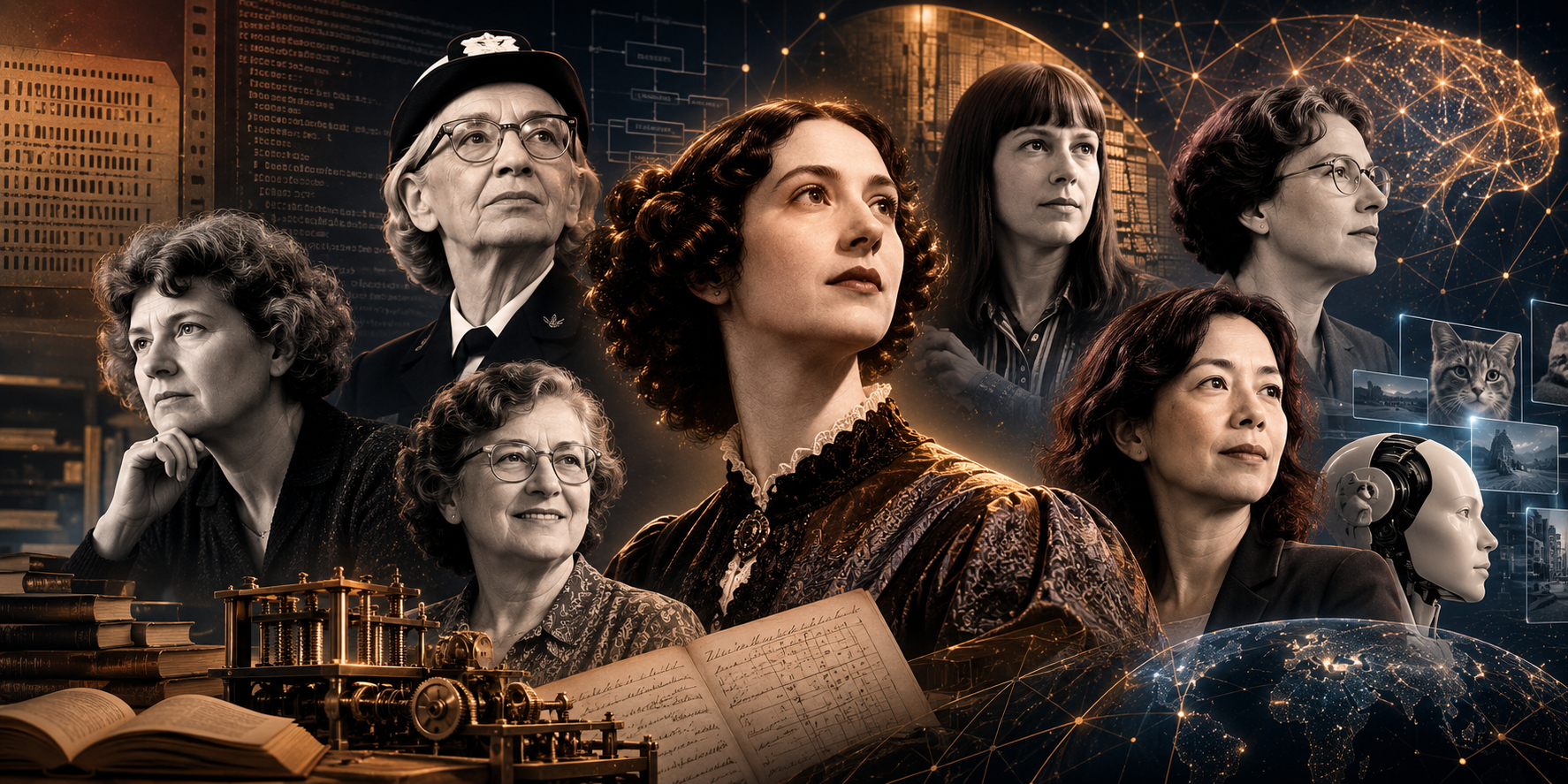
Ada Lovelace thought about what a general-purpose calculating machine might do before such a machine existed. Grace Hopper helped make computers programmable without requiring humans to communicate entirely on the machine's terms. Lynn Conway helped transform the design of complex computer chips. Frances Allen developed techniques for making programs execute more efficiently. Karen Spärck Jones helped machines determine which pieces of information matter. Radia Perlman helped make large computer networks reliable. Fei-Fei Li helped demonstrate what machine learning could do when algorithms were given enormous, carefully organised collections of examples.
This is not a definitive list of the women behind artificial intelligence. It is a deliberately selective history of seven people whose work illuminates different layers of the infrastructure modern AI depends upon: representation, programming, hardware, optimisation, retrieval, networking and data.
Not all seven worked in artificial intelligence. That distinction matters. Calling every important contribution to computing "AI" merely because AI later depended upon it would make the history simpler and the science worse.
Their significance is different.
They helped construct the intellectual and technological environment from which modern artificial intelligence became possible.
Before a machine could learn from the world, somebody had to build a world the machine could compute.
Ada Lovelace and the Question That Came Before Artificial Intelligence
Artificial intelligence begins with an awkward prerequisite.
You need a computer.
Ada Lovelace did not have one.
In the 1840s, she studied Charles Babbage's plans for the Analytical Engine, a proposed mechanical calculating machine of extraordinary ambition. The machine was never completed in Babbage's lifetime, but Lovelace began thinking seriously about what it might do.
While translating a paper about the Analytical Engine, she added extensive notes of her own. One described a procedure by which the machine could calculate Bernoulli numbers, helping establish her later reputation as the "first computer programmer."
As usual, the label is less interesting than what lies underneath it.
Lovelace recognised that a sufficiently general calculating machine might manipulate symbols according to formal rules. Numbers did not necessarily have to represent quantities; they could stand for something else.
Music, for example.
If musical relationships could be expressed symbolically, Lovelace speculated, a machine might conceivably manipulate them. The idea contains something surprisingly modern.
A computer does not know that a value stored in its memory represents a colour, a word, a sound, a financial transaction or part of an image. Humans establish the representation; the machine manipulates it.
Modern artificial intelligence operates on a scale beyond anything Lovelace could have imagined, but it depends upon the same fundamental abstraction. Language becomes tokens and numerical representations. Images become arrays of values. Sound becomes digital data. The computer processes a representation of the thing rather than experiencing the thing itself.
Lovelace also made a famous caution. The Analytical Engine, she argued, had no ability to originate anything; it could perform only what humans knew how to instruct it to perform.
More than a century later, Alan Turing explicitly considered what became known as "Lady Lovelace's objection" while asking whether machines might think.
The argument has never entirely disappeared.
When a generative AI system produces something nobody has seen before, has the machine originated it? Or has an extraordinarily complicated mathematical process generated something new from patterns ultimately learned from human-created information?
The machinery has changed beyond recognition.
The philosophical argument was waiting for it.
Lovelace was asking what a programmable machine could mean before there was a programmable machine available to answer her.
Artificial intelligence would inherit the question.
Grace Hopper and the Problem of Speaking to the Machine
The earliest electronic computers were powerful in a very particular way: they could perform calculations extremely quickly.
Getting them to perform the calculation you wanted was another matter.
Programming required humans to accommodate themselves to the architecture of the machine. Grace Hopper thought this arrangement could be improved.
Hopper began programming the Harvard Mark I during the Second World War and later worked with some of the earliest commercial computers, including UNIVAC. Her central instinct was that programming should become more accessible to human beings.
Computers should do more of the translation.
Her work on early compilers helped make that possible. A compiler takes instructions written in a higher-level form and translates them into operations a computer can execute.
It is difficult now to appreciate how important this abstraction became. We are accustomed to programmers writing in specialised languages while layers of software deal with the machinery underneath. Early computing offered no reason to assume that this arrangement would become normal.
Hopper helped make it normal.
She later developed FLOW-MATIC, an English-oriented data-processing language that influenced COBOL and helped push programming toward forms that were easier for humans to read and write.
Modern artificial intelligence depends on abstraction stacked upon abstraction. A researcher developing a machine-learning model does not normally specify individual processor instructions. She writes code in a programming language; libraries translate higher-level mathematical operations; compilers transform programs; hardware executes the result.
Without these layers, modern AI development would be almost absurdly cumbersome.
There is a pleasing progression here. Lovelace imagined what symbolic instructions might mean. Hopper helped make those instructions practical.
The computer was becoming easier to tell what to do.
That mattered because artificial intelligence would eventually require programs far too complicated to express comfortably at the level of individual machine operations.
Lynn Conway and the Hardware Design Revolution
Software receives most of the attention in artificial intelligence, but hardware pays the electricity bill.
Modern AI systems require staggering amounts of computation, and that computation has to happen on physical machines whose complexity has itself been engineered over generations.
Lynn Conway belongs to an important part of that history.
During the 1970s, Conway worked with Carver Mead on methods that transformed the design of very-large-scale integrated circuits, or VLSI.
The problem was becoming urgent. As engineers learned to place increasing numbers of transistors onto a single chip, older approaches to chip design became increasingly difficult to manage. More transistors meant more capability, but also a design problem of rapidly increasing complexity.
Mead and Conway helped develop systematic methods that allowed designers to work with complex integrated circuits at a more manageable level. Their approach included scalable design rules, structured methods for describing circuits and a methodology that could be taught to a much wider community of designers.
The result became associated with the Mead-Conway VLSI design revolution.
This changed not only what chips could contain but how they could be created. Complex chip design became more systematic, more teachable and more accessible to designers who did not need to master every detail of the fabrication process before developing sophisticated circuits.
Computational ambition is limited by computational machinery.
Modern machine learning expanded dramatically when hardware became capable of performing enormous numbers of calculations efficiently and in parallel. Graphics processors, specialised accelerators and vast data-centre systems belong to a longer history in which the complexity of hardware first had to become manageable.
Conway helped change the rules of that design process.
AI may look like mathematics running somewhere in the cloud.
Somewhere underneath, there is still silicon.
Frances Allen and the Programs That Run Better Than We Wrote Them
A programmer writes a program.
The computer does not necessarily have to execute it exactly as written.
Frances Allen pioneered techniques that allowed compilers to analyse programs, reorganise instructions and identify opportunities for more efficient execution without changing what the program was supposed to do.
A calculation might be repeated unnecessarily. A loop might be reorganised. Instructions might be moved or combined. Parts of a program might be arranged so that several processors could perform work simultaneously.
Allen's research at IBM helped establish foundational techniques in program optimisation, data-flow analysis and parallelisation.
These ideas became increasingly important as computers grew more complicated.
Modern AI workloads make the reason obvious. Training a large machine-learning model can require enormous numbers of repeated numerical operations. At that scale, inefficient execution is not merely inelegant.
It becomes time, energy, hardware and money.
A modern researcher may express a model in relatively compact high-level code while an enormous software stack underneath determines how those calculations should actually be performed by the hardware.
Compiler optimisation is part of what makes that separation possible.
Allen helped build the intellectual foundations of that machinery. In 2006, she became the first woman to receive the ACM A.M. Turing Award.
The honour recognised achievements in computing that began long before today's AI boom.
The consequences reach directly into it.
AI requires clever algorithms.
It also requires those algorithms to finish running.
Karen Spärck Jones and the Problem of Finding What Matters
The internet contains an enormous amount of information.
This becomes less impressive if a computer cannot determine which part you actually wanted.
Karen Spärck Jones spent much of her career working on that problem.
She was a pioneer in information retrieval and natural-language processing: fields concerned with how machines process human language and find relevant information in large collections of documents.
One of her most influential contributions was an idea known as inverse document frequency.
Its basic insight is wonderfully simple.
Not every word tells you equally much about a document.
Suppose you search a collection containing a million articles. A word appearing in almost every article probably tells you very little about which one is relevant. A word appearing in only a small number may be much more informative.
Spärck Jones formalised this intuition.
A term's importance should depend not merely on how frequently it appears inside one document, but on how rare it is across the collection.
This became foundational to information retrieval.
And it offers a useful bridge into modern artificial intelligence.
AI systems increasingly operate in a world where the problem is not lack of information.
It is excess.
Which words matter? Which document matters? Which part of a document answers the question? Which piece of context should influence the model's response?
Modern search engines and AI retrieval systems use methods vastly more sophisticated than classical inverse document frequency alone, but the underlying problem has not disappeared.
Relevance has to be computed.
A machine must distinguish information from useful information.
That distinction is harder than it sounds. The word "the" may appear fifty times in a document and tell us almost nothing. A rare technical term appearing twice may reveal exactly what the document is about.
Spärck Jones helped establish a mathematical way of expressing that difference.
There is an irony in modern AI's apparent fluency. A system may produce paragraphs that look effortless, while underneath, enormous amounts of computational machinery are deciding which patterns, words, documents and representations deserve more weight than others.
The machine does not merely need information.
It needs significance.
Spärck Jones spent decades asking how a computer might approximate it.
Radia Perlman and the Problem of Connecting Everything
Imagine building the world's most sophisticated artificial intelligence system and then disconnecting every network cable.
It remains sophisticated.
It has also become substantially less useful.
Modern AI is inseparable from networking. Training data travels through networks. Computational work is distributed across machines. Models are deployed through cloud infrastructure. Users interact with systems remotely. Information is retrieved from servers distributed across the world.
Radia Perlman helped solve one of networking's fundamental problems.
As computer networks grow, redundancy becomes necessary. If only one connection exists between two parts of a network and that connection fails, communication stops.
Add alternative paths and reliability improves.
Unfortunately, careless redundancy creates loops. Data can circulate repeatedly through a network, consuming resources and potentially making the system unusable.
Perlman developed the spanning tree protocol, which allowed network bridges to establish a loop-free logical structure while retaining redundant physical connections that could become useful when the network changed.
The engineering is elegant partly because users do not need to know it is happening.
The network simply works.
Perlman has often been called the "mother of the Internet."
This is catchy.
It is also precisely the kind of phrase computer history could do with less of.
The internet did not have a mother. It had protocols, researchers, engineers, institutions and decades of technical decisions.
Perlman's actual contribution is more interesting than a parental nickname.
She helped solve a fundamental problem in making networks resilient and scalable.
And scale changed computing.
A computer was no longer merely a machine.
It became a node.
That transformation is now fundamental to artificial intelligence. A contemporary model may be trained across large numbers of processors, accessed simultaneously by millions of users and supplemented with information retrieved from other systems.
The intelligence may appear to live inside the model.
Its usefulness depends partly upon everything connecting it to the rest of the world.
Fei-Fei Li and the Problem of Teaching a Machine to See
For decades, researchers tried to make computers recognise objects.
The problem looked deceptively simple.
A child can distinguish a dog from a chair.
Surely a computer could be taught to do the same.
Computers objected.
An object does not have one mathematical appearance. The same dog can be photographed from different directions, partly hidden, brightly illuminated or barely visible. Objects belonging to the same category may look remarkably unlike one another.
Human vision handles this variation so effortlessly that we tend to underestimate the problem.
Machine vision did not have that luxury.
Fei-Fei Li became convinced that one part of the problem was scale.
Machine-learning systems needed examples.
Lots of them.
Rather than relying on comparatively small collections of images, Li and her collaborators began constructing something far larger.
ImageNet.
The project organised images according to concepts derived from WordNet and ultimately assembled millions of labelled examples across thousands of categories.
The breakthrough was not simply collecting photographs.
The photographs had to mean something.
An image had to be associated with a category. Human workers had to label and verify examples. Concepts had to be organised. The machine needed both data and structure.
Then, in 2012, something dramatic happened.
A deep convolutional neural network developed by Alex Krizhevsky, Ilya Sutskever and Geoffrey Hinton achieved a striking improvement in the ImageNet competition.
Deep learning had existed before ImageNet. Neural networks had existed for decades. Graphics processors were becoming increasingly powerful. Large datasets were becoming available.
The pieces met.
Computer vision changed quickly afterwards.
This is why the story cannot accurately be reduced to "Fei-Fei Li invented modern AI."
She didn't.
Nor did ImageNet single-handedly cause the deep-learning revolution.
It supplied something emerging methods desperately needed: scale, structure and a common benchmark against which progress could be measured.
The lesson reaches beyond computer vision.
Modern machine learning depends profoundly upon data. Algorithms learn patterns from examples, which means the quantity, quality and organisation of those examples influence what the system can learn.
A bad dataset can produce a bad model.
An unrepresentative dataset can produce systematic failures.
Labels encode human decisions. Categories contain assumptions. The apparently mundane work of constructing a dataset therefore becomes part of the behaviour of the resulting system.
Li's work helped make that visible.
The question was no longer merely, "How do we design an algorithm clever enough to recognise an object?"
It became something larger:
What happens if we give the algorithm enough of the world to learn from?
Artificial intelligence had encountered one of its defining modern resources.
Not a new equation.
Data at scale.
When Artificial Intelligence Became an Accumulation
There is a persistent desire to identify the person who invented artificial intelligence.
It is understandable.
Names are easier than systems.
Alan Turing asks whether machines can think. John McCarthy coins the term artificial intelligence. Geoffrey Hinton becomes associated with neural networks. A sequence of individuals can be arranged neatly enough to fit onto a timeline.
The problem is that artificial intelligence does not.
AI is not one invention.
It is an accumulation of intellectual infrastructure.
To build a modern AI system, information has to be represented in a form a computer can process. Lovelace was thinking about that problem before electronic computers existed.
Humans need practical ways to instruct machines. Hopper helped build them.
The physical computers themselves must become sufficiently complex and powerful. Conway helped transform how complex integrated circuits could be designed.
Programs have to execute efficiently. Allen helped develop the machinery underneath sophisticated compiler optimisation.
Information has to be retrieved and ranked. Spärck Jones helped establish mathematical foundations for determining which terms and documents are informative.
Computers have to communicate reliably. Perlman helped solve fundamental problems in network architecture.
Machine-learning systems require sufficiently rich examples from which patterns can be learned. Li helped demonstrate the power of constructing those examples at unprecedented scale.
None of these steps produces artificial intelligence by itself.
Together they create the environment in which artificial intelligence can exist.
The current AI boom can therefore look sudden only if one begins the story too late.
The public experience arrived quickly.
The infrastructure did not.
Then the Data Became Part of the Machine
Classical computer programs are usually written as explicit instructions: do this, then this, and if this condition is true, do something else.
Machine learning changes the arrangement.
Rather than specifying every rule needed to solve a problem, programmers construct systems capable of adjusting themselves from examples. The examples therefore become part of the system's behaviour.
This is what makes ImageNet such a revealing moment.
The dataset was not merely fuel poured into an otherwise complete machine. It helped define the problem.
What counted as an object category? Which examples represented that category? How many examples were enough? How should performance be measured?
These decisions shaped what researchers built.
Modern AI has made the relationship even more obvious. Large models consume immense quantities of text, images, audio and other data.
The quality of those materials matters. Their biases matter. Their omissions matter. Who created them matters. Who labelled them matters. What was excluded matters.
Artificial intelligence is sometimes described as though algorithms look directly at the world and independently learn what is there.
They don't.
They encounter representations of the world assembled through technical and human systems.
The same is true when AI retrieves information. A model may appear to answer a question directly while a retrieval system behind it identifies documents, ranks them and determines which context should be supplied.
The modern techniques differ profoundly from the information-retrieval systems Karen Spärck Jones worked on.
The old problem remains.
Out of everything available, what matters here?
AI does not escape the history of information processing.
It intensifies it.
The Foundations Become Invisible
There is a final irony.
The more successful computing infrastructure becomes, the less visible it is.
Nobody using an AI assistant thinks about compiler optimisation. Nobody generating an image wonders how packets are travelling through network switches. Nobody running a machine-learning model pauses to contemplate semiconductor design methodology. Nobody expects a search result to include a small tribute to the history of information retrieval.
The technology works.
The layers disappear.
This is not unique to artificial intelligence. Every mature technology hides its own history.
But AI hides it particularly well because the final system appears almost self-contained.
A prompt goes in.
An answer comes out.
The machine seems to be doing everything.
It isn't.
Behind the model sit representations, programming languages, compilers, chips, networks, retrieval systems, datasets and decades of computer science. Around it sit researchers, engineers and data workers deciding what will be built, what information will be used and how success will be measured.
The women in this history did not secretly invent artificial intelligence.
They solved problems artificial intelligence later inherited.
Ada Lovelace considered how machines might manipulate symbolic representations. Grace Hopper helped make machines easier for humans to instruct. Lynn Conway helped make increasingly complex computing hardware possible to design at scale. Frances Allen helped programs execute more efficiently on increasingly sophisticated machines. Karen Spärck Jones helped formalise how computers distinguish useful information from ubiquitous noise. Radia Perlman helped networks remain reliable as computing became connected. Fei-Fei Li helped show what machine learning could become when algorithms were given organised examples at enormous scale.
They worked on different problems in different decades.
History connected the problems later.
That may be the most useful way to understand artificial intelligence.
Not as a sudden invention, but as a structure built on structures built on structures.
Today the model gets the attention.
The foundations usually don't.
They are still holding it up.