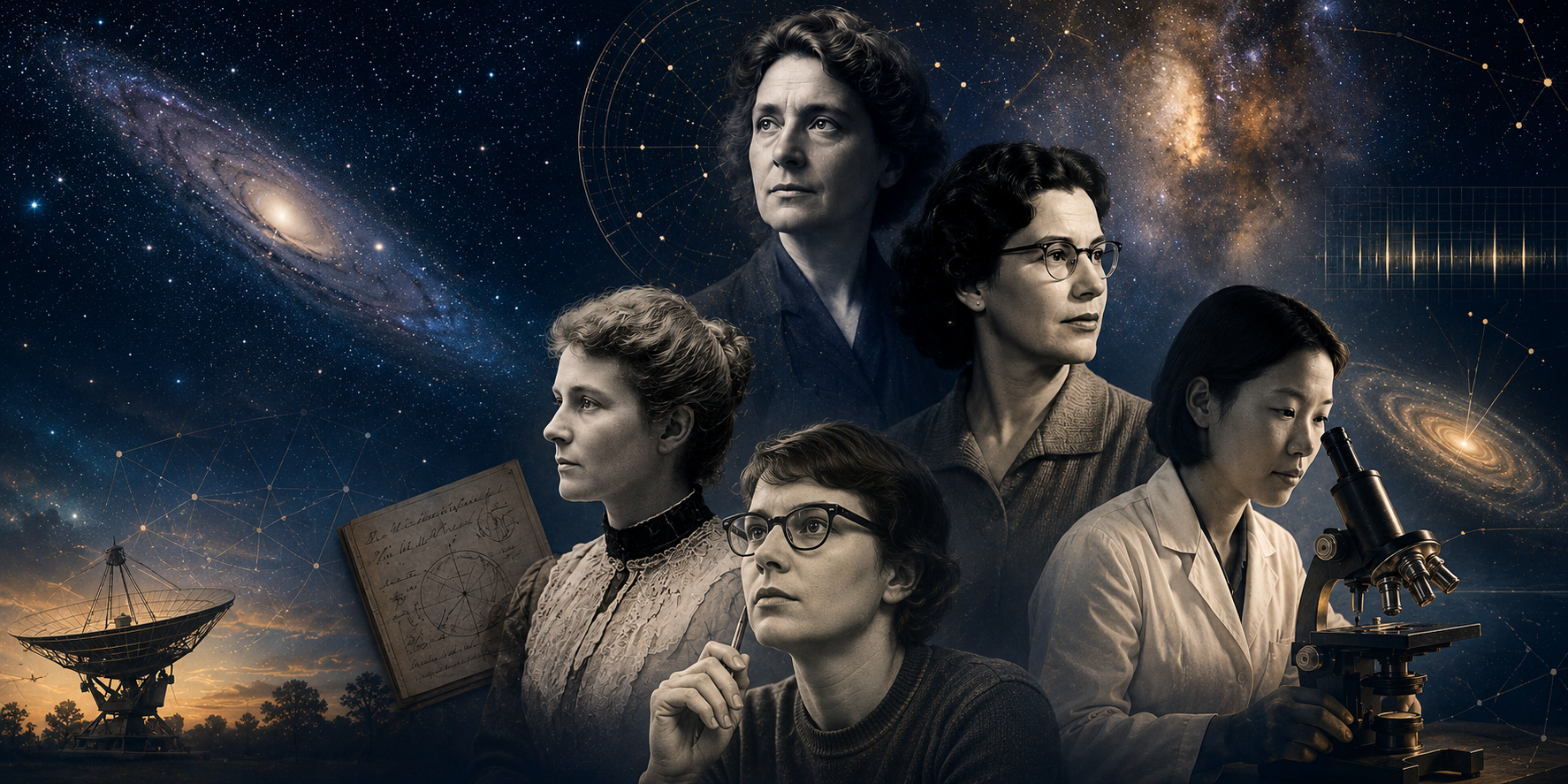
The Women Who Changed Our Understanding of the Universe
Six astronomers uncovered the distance, composition, evolution, and hidden structure of the cosmos.
The universe is extremely good at concealing its scale.
Look up at the night sky and almost everything appears to be arranged on the same dark surface. A nearby star and a distant galaxy can both look like points of light. A star gives no obvious indication of what it is made of. A galaxy does not announce how old it is, how it formed or how much invisible matter surrounds it.
For most of human history, the sky offered light without explanation.
Then astronomers learned how to extract information from it.
A star that brightens and fades can reveal distance. A spectrum can reveal chemical composition. The colours of galaxies can preserve evidence of their past. The movement of stars can expose matter that cannot be seen. A tiny source of radio pulses can reveal an object so dense that a teaspoon of its material would weigh billions of tonnes. The orbit of a star around apparently empty space can betray the presence of a black hole millions of times the mass of the Sun.
None of these discoveries arrived as a single revelation.
Our modern picture of the universe was assembled gradually, and often indirectly. Astronomers learned to treat light, motion and time as evidence.
Women were central to that process.
Henrietta Swan Leavitt gave astronomy a way to measure enormous distances. Cecilia Payne-Gaposchkin established what stars are actually made of. Beatrice Tinsley transformed understanding of how galaxies evolve. Vera Rubin showed that visible matter could not explain how galaxies move. Jocelyn Bell Burnell discovered the signal that revealed pulsars. Andrea Ghez helped prove that a supermassive black hole sits at the centre of our own galaxy.
Their work spans nearly a century.
Together, it tells a larger story.
How did the universe stop being a collection of lights and become a physical place we could measure?
Henrietta Leavitt and the Stars That Became Rulers
Astronomy has a distance problem.
The farther away something is, the fainter it generally appears.
Unfortunately, a faint star might be very distant.
Or it might simply be dim.
Looking at brightness alone does not tell you which.
At the beginning of the twentieth century, this made the scale of the universe extraordinarily difficult to establish.
Henrietta Swan Leavitt found a way through the problem by studying stars in photographs.
Leavitt worked at the Harvard College Observatory. She was part of a team of women who examined and classified astronomical photographic plates.
They were called computers.
The word had not yet been handed over to machines.
Leavitt studied variable stars in the Magellanic Clouds. These are small galaxies seen from the Southern Hemisphere. Some of these stars, called Cepheid variables, brighten and fade in a regular cycle.
She noticed something important.
The brighter Cepheids took longer to complete that cycle.
The stars in each Magellanic Cloud are about the same distance from Earth. This means their brightness differences relate closely to their actual luminosity.
So, the variation period can show how bright a Cepheid truly is.
When astronomers grasp this, they can compare a Cepheid's actual brightness with how faint it appears from Earth. This helps them estimate its distance.
The star had become a measuring instrument.
This sounds technical because it is.
It is also one of the foundations of modern cosmology.
Leavitt's period-luminosity relation allowed astronomers to measure distances much greater than what direct stellar parallax can reach.
Edwin Hubble later used Cepheid variables to show that the Andromeda "nebula" was not a nearby cloud inside the Milky Way.
It was another galaxy.
Suddenly the universe became much larger.
Leavitt did not personally discover the expanding universe.
She did something more foundational.
She gave later astronomers a ruler long enough to measure it.
There is an irony in this.
Leavitt spent much of her career measuring star brightness. She worked in a system that offered her little freedom to shape her own research programme.
She was extraordinarily good at finding distances.
Her own career had rather less room to travel.
Cecilia Payne-Gaposchkin and What the Stars Are Made Of
Once astronomers could begin measuring the universe, another basic question remained.
What was in it?
The Sun looks solid enough.
So do the stars.
For a long time, many astronomers assumed that stars probably contained elements in roughly the same proportions as Earth.
It was not an absurd assumption.
It was also wrong.
Cecilia Payne arrived at Harvard in the 1920s and began studying stellar spectra.
When light from a star is spread into its component wavelengths, dark and bright lines appear at particular positions. These spectral lines contain information about the atoms present in the star's atmosphere.
But interpreting them is not as straightforward as spotting an element's signature and counting.
Temperature changes which spectral lines appear strongly.
A star may contain large amounts of an element that produces relatively weak lines under particular conditions.
Payne applied the emerging physics of ionisation to the problem.
Her conclusion was startling.
Hydrogen and helium were overwhelmingly more abundant in stars than heavier elements such as iron, silicon and oxygen.
The stars were not chemically similar to Earth.
They were mostly made of the two lightest elements in the periodic table.
This was so unexpected that Payne was initially encouraged to describe the conclusion cautiously.
A few years later, other astronomers confirmed it.
Today, saying that stars are mostly hydrogen and helium barely qualifies as astronomy trivia.
It appears in school science.
That familiarity hides the scale of the correction.
Payne did not discover a small difference in stellar chemistry.
She helped establish what most of the visible matter in the universe is made of.
The stars had been above humanity for as long as humanity had existed.
We had been looking at hydrogen all along.
We simply did not know it.
Beatrice Tinsley and the Galaxies That Refused to Stay the Same
A photograph of a galaxy can give the impression of permanence.
A spiral hangs in space.
An elliptical glows quietly.
It is easy to imagine that galaxies are finished objects.
Beatrice Tinsley helped make that view impossible to maintain.
Tinsley studied how galaxies evolve over cosmic time.
The problem required astronomy to think historically.
A galaxy's light is not produced by a single kind of star. It is the combined result of enormous populations of stars of different masses, ages and chemical compositions.
Those populations change.
Massive stars live quickly and die young.
Smaller stars can survive for billions of years.
New generations form from material enriched by earlier generations.
The colour and brightness of a galaxy therefore change as its stellar population ages.
TInsley created models that explain how these populations evolve. This evolution impacts what astronomers see.
This had important consequences.
If a distant galaxy looks different from a nearby one, the difference may not mean that it belongs to an entirely different type of object.
Part of what we are seeing may be evolution.
And because light takes time to reach us, distant galaxies are also being observed at earlier stages of cosmic history.
Astronomy had acquired a time machine simply by looking farther away.
Tinsley's work helped transform the study of galaxies from classification toward evolution.
Galaxies were no longer merely objects to sort by shape.
They had biographies.
They formed stars.
They changed chemically.
Their brightness evolved.
They interacted with their environments.
They aged.
Tinsley's own career contained a less cosmic struggle with time.
She carried out much of her early research while managing family duties. Also, she faced challenges from academic institutions that made dual scientific careers tough.
Eventually she became a professor at Yale.
She died of cancer in 1981 at the age of forty.
Her scientific influence continued expanding afterwards.
Galaxies, she had shown, must be understood as things in time.
So, unfortunately, must scientific careers.
Vera Rubin and the Matter We Cannot See
By the 1970s, astronomers had become quite good at observing galaxies.
Then Vera Rubin helped show that observation was not enough.
Rubin and her colleague Kent Ford measured how quickly stars and gas moved around spiral galaxies.
The expectation seemed straightforward.
Most of a galaxy's visible matter is concentrated toward its centre.
Farther out, where less visible mass lies inside an orbit, stars ought to move more slowly.
This is roughly what happens in the Solar System.
Mercury travels around the Sun faster than Neptune.
Galaxies did not cooperate.
Rubin found that stars far from galactic centres continued orbiting at unexpectedly high speeds.
The rotation curves remained roughly flat.
Visible matter could not provide enough gravity to explain the motion.
Something else appeared to be there.
It did not shine.
It did not reveal itself through ordinary telescopes.
But its gravity was difficult to ignore.
The idea of unseen matter in astronomy was not new, and Rubin was not the first scientist to propose dark matter.
Her observations did something crucial, however.
They showed strong evidence that the missing mass problem was common in spiral galaxies.
The universe appeared to contain far more matter than telescopes could see.
This is one of astronomy's more unsettling achievements.
Centuries of telescope building had been devoted to seeing more.
Better instruments revealed fainter stars, distant galaxies and deeper regions of space.
And after all that improvement in seeing, astronomers were forced to conclude that most of the matter was invisible.
Dark matter remains unidentified.
We see its presence through gravity and other effects. However, its true nature remains one of the biggest mysteries in physics.
Rubin therefore helped establish something unusual.
A discovery of ignorance.
We learned that there was far more universe than our eyes — or even our telescopes — could account for.
Jocelyn Bell Burnell and the Signal That Shouldn't Have Been There
Some astronomical discoveries begin with beautiful images.
This one began with a small irregularity on a paper chart.
In 1967, Jocelyn Bell was a graduate student at Cambridge working on a new radio telescope designed to study quasars.
The instrument produced enormous quantities of data.
The data were printed on long rolls of paper.
Bell examined them.
Carefully.
She noticed a bit of "scruff" among the usual traces. This signal didn’t look like normal radio interference or astronomical sources.
Then it returned.
The pulses were surprisingly regular.
For some time, people thought the signal might come from an alien civilisation. They jokingly named it LGM-1.
Little Green Men.
The explanation eventually became less sociable but more extreme.
The pulses came from a rapidly rotating neutron star.
A pulsar.
Neutron stars had been predicted theoretically decades earlier. They are the collapsed remnants of massive stars, packing enormous mass into an object roughly the size of a city.
A pulsar rotates rapidly and beams radiation through space. If that beam sweeps across Earth, radio telescopes receive a pulse with each rotation.
The star behaves rather like a cosmic lighthouse.
Except that lighthouses are not made from matter crushed close to nuclear density.
Bell Burnell's observation helped establish an entirely new field of pulsar astronomy.
Pulsars became key tools for studying gravity, the interstellar medium, and extreme matter.
The 1974 Nobel Prize in Physics honoured Antony Hewish and Martin Ryle for their work in radio astrophysics. This included Hewish's role in discovering pulsars.
However, Bell Burnell was not included.
Her exclusion has sparked debate ever since.
She has often shared a more nuanced view than the usual story of a graduate student wronged by her supervisor. She highlights the recognition norms in science at that time.
The debate matters.
But so does the signal.
The most striking part of Bell Burnell's story may be simpler.
An instrument generated kilometres of data.
Something strange appeared in it.
She noticed.
Astronomy depends on enormous machines.
It still requires somebody to realise when the universe is behaving oddly.
Andrea Ghez and the Darkness at the Centre of the Milky Way
The centre of our galaxy is difficult to see.
There are stars there.
There is gas.
There is dust.
And behind all of that lies something extraordinarily massive that emits almost no light of its own.
Andrea Ghez helped show what it is.
For decades, astronomers suspected that a supermassive black hole might occupy the centre of the Milky Way.
The challenge was proving it.
A black hole cannot be photographed in the ordinary way.
But gravity leaves evidence.
Ghez and her team used powerful telescopes at the W. M. Keck Observatory in Hawaii to track individual stars moving near the galactic centre.
This required extraordinary precision.
Earth's atmosphere can blur astronomical images. So, Ghez used techniques to reduce this distortion. These methods helped him spot stars in one of the busiest parts of the sky.
Then the stars began to move.
Not slightly.
Some travelled at enormous speeds around an apparently empty point.
One star, known as S2 or S0-2, follows a highly elliptical orbit, completing a journey around the galactic centre in roughly sixteen years.
Its path gives astronomers a way to calculate the mass concentrated inside the orbit.
The answer is about four million times the mass of the Sun.
Packed into a region so small that the most convincing explanation is a supermassive black hole.
The object is associated with the radio source Sagittarius A*.
In 2020, Ghez shared half of the Nobel Prize in Physics with Reinhard Genzel. They discovered a supermassive compact object at the centre of our galaxy. Roger Penrose received the other half for his theoretical work. He showed that black hole formation is a strong prediction of general relativity.
The story closes a rather elegant circle.
Henrietta Leavitt helped astronomers use stars to measure enormous distances.
Andrea Ghez used stars to measure something that could not itself be seen.
The stars had become rulers again.
This time, they were measuring darkness.
From Points of Light to a Physical Universe
There is a tendency to imagine astronomical progress as a story of better telescopes.
Build a larger mirror.
Collect more light.
See farther.
Certainly that matters.
But instruments alone do not explain how our picture of the universe changed.
The transformation came from learning how to interpret what the instruments saw.
Henrietta Leavitt looked at stars changing in brightness and found a scale for measuring distance.
Cecilia Payne-Gaposchkin looked at spectral lines and discovered the chemical composition of stars.
Beatrice Tinsley looked at populations of stars and showed that galaxies themselves evolve.
Vera Rubin looked at orbital motion and found evidence for matter that emitted no light.
Jocelyn Bell Burnell looked at an unexpected radio signal and revealed a new kind of collapsed star.
Andrea Ghez looked at stars racing around empty space and used their motion to expose a black hole.
None of these women simply looked harder.
They learned to treat apparently indirect evidence as something physical.
Brightness became distance.
Colour became chemistry.
Stellar populations became history.
Motion became mass.
Radio pulses became collapsed stars.
Orbits became proof of something invisible.
That may be astronomy's most impressive habit.
The universe does not have to show us an object directly.
It only has to leave enough clues.
The Universe Became Larger, Stranger and Less Visible
Scientific progress is often described as the replacement of mystery with knowledge.
Astronomy provides a useful correction.
Sometimes knowledge creates better mysteries.
Leavitt's work helped reveal that the universe extended far beyond the Milky Way.
Payne showed that its stars were overwhelmingly made from elements far lighter than the Earth beneath our feet.
Tinsley demonstrated that galaxies change across cosmic time.
Rubin helped establish that visible matter accounts for only part of the gravity holding galaxies together.
Bell Burnell revealed objects in which matter had been crushed into conditions almost impossible to reproduce on Earth.
Ghez helped establish that the centre of our own galaxy contains a supermassive black hole.
Each answer enlarged the unknown.
Measure the universe and it becomes bigger.
Analyse the stars and they turn out to be made of unexpected material.
Understand galaxies and much of their mass disappears from view.
Study apparently empty space and find millions of solar masses hiding inside it.
The universe became more understandable.
It did not become more ordinary.
That distinction matters. The women in this history often appear through another story: women who overcame barriers in astronomy.
They did.
Henrietta Leavitt worked in a system that hired women for detailed analysis. However, it offered few chances for advancement.
Cecilia Payne-Gaposchkin encountered scepticism toward a conclusion that later became foundational.
Beatrice Tinsley faced pressures common to many women balancing research and family duties.
Vera Rubin dealt with institutions that were slow to accept women as regular members of the astronomical field.
Jocelyn Bell Burnell became part of one of the most persistent debates about scientific credit in modern astronomy.
Those histories matter.
But if we remember only the barriers, we commit another kind of reduction.
These women were not important because discrimination happened to them.
They were important because they changed astronomy.
Their work altered the scale of the universe, its chemistry, its history and its contents.
That is the larger story.
We began with points of light.
By the end, those lights became measuring tools, chemical labs, clocks, and gravitational probes.
And the darkness between them had become evidence too.
The universe had not changed.
Our ability to read it had.
That may be what scientific discovery does at its best.
It does not make the cosmos smaller by explaining it.
It gives us more universe to understand.