When Did Computing Become a Man’s World?
Programming was once a field in which women were unusually visible. Then computing became more prestigious, more professionalised and more culturally masculine. What happened?
Programming was once a field in which women were unusually visible. Then computing became more prestigious, more professionalised and more culturally masculine. What happened?
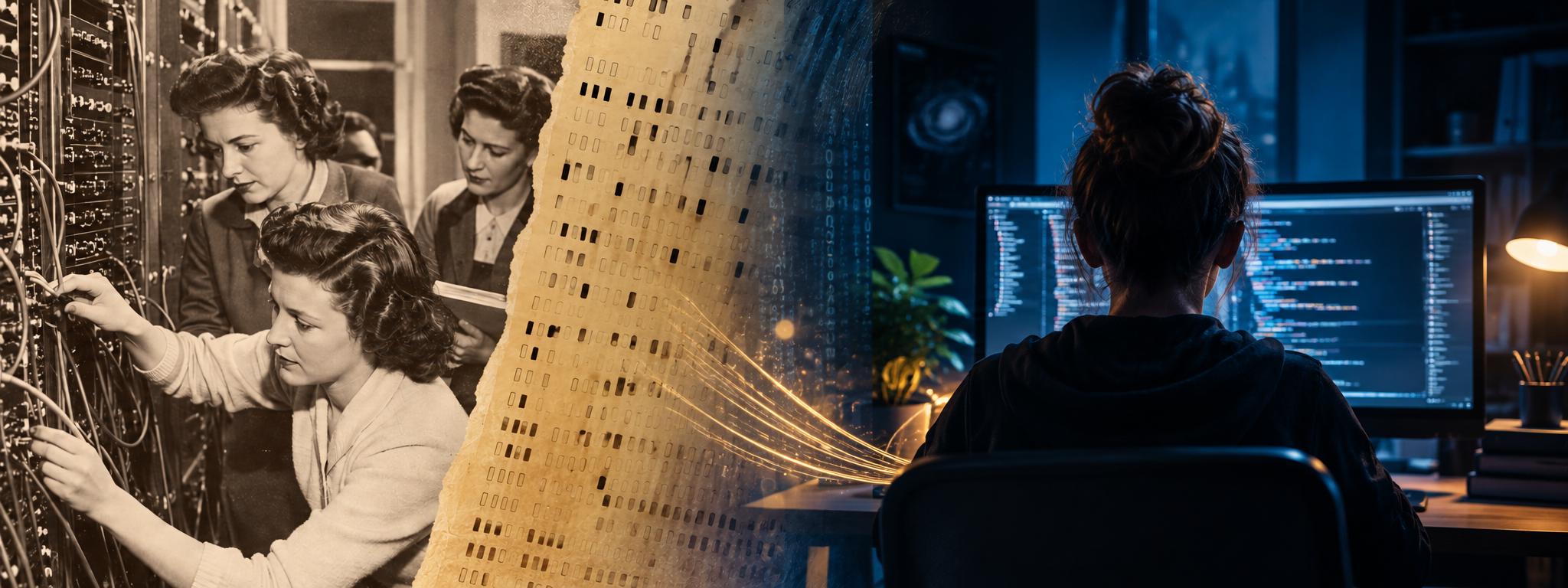
Look at a photograph of an early electronic computer and it is easy to misunderstand what you are seeing. The machine dominates the frame: cabinets, cables, switches and panels. The people standing beside it can look almost incidental.
In photographs of ENIAC, some of those people are women.
They were not there simply to operate a machine designed and programmed elsewhere. Six women — Kathleen McNulty, Frances Bilas, Betty Jean Jennings, Ruth Lichterman, Marlyn Wescoff and Frances Snyder — were selected to program ENIAC. They had to work out how to translate mathematical problems into sequences the machine could execute. With no modern programming language and no established programming profession to guide them, they learned the machine from diagrams and developed ways of configuring it to solve different problems.
This does not mean that the birth of computing was an age of gender equality. It was not. But it reveals something that now seems surprising: programming was not always imagined as naturally male work.
The transformation that followed tells us something important about the relationship between gender and technology.
When “Computer” Meant a Person
The word “computer” once referred to a person.
Large calculations could be divided among teams of human computers who repeatedly performed sections of mathematical work. During the Second World War, women were recruited in substantial numbers for this kind of calculation. In the United States, women working for the Army calculated artillery firing tables using mechanical calculators.
When ENIAC was developed to automate those calculations, women who had worked as human computers were among those recruited to program it. The women did not simply disappear when calculation became electronic. Some moved directly from performing calculations themselves to instructing machines how to perform them.
Programming ENIAC was anything but clerical. The programmers needed to understand the mathematics of the problem, the architecture of the machine and the movement of information through its components. Programming could involve physically configuring switches and cables across the enormous computer.
Yet the prestige attached to different parts of the project was uneven. Hardware was more readily understood as engineering. Programming was new, poorly defined and initially lacked the professional status it would later acquire.
Historian Janet Abbate has documented how women became an important part of the early programming workforce in both Britain and the United States.
That makes the modern stereotype particularly interesting.
If programming was intrinsically masculine, why did its early history look so different?
Before Computing Had Gatekeepers
Part of the answer is that early programming had not yet become an established profession. There was no conventional route into it.
There were few computer-science degrees because computer science barely existed as an academic discipline. Employers recruited mathematicians, scientists, clerical workers and people who demonstrated an aptitude for logical problem-solving.
That uncertainty created unusual openings.
Grace Hopper, trained as a mathematician, worked on the Harvard Mark I during the Second World War and later joined the company developing UNIVAC. She went on to develop pioneering compiler technology and became an important figure in the development of COBOL.
In Britain, women also occupied important positions in the emerging computer workforce. Mary Coombs became the first woman to program LEO, the computer developed by the Lyons company for business applications.
Stephanie Shirley went considerably further. In 1962, she founded Freelance Programmers, a software company designed to create employment opportunities for skilled programmers, particularly women seeking flexible work. Many worked from home, an unusual arrangement at the time.
The existence of such careers should not be romanticised. Women encountered restrictions in pay, promotion and professional recognition. But programming’s novelty mattered: a profession whose hierarchy had not yet completely formed could sometimes provide opportunities that were harder to find in older scientific and engineering institutions.
Then the hierarchy began to form.
When Programming Became a Profession
During the first decades of electronic computing, the machine itself appeared to be the scarce and expensive resource. Computers occupied rooms and cost enormous sums; software was less visible.
That relationship changed.
As businesses, governments and scientific institutions became increasingly dependent on computers, software became critical infrastructure. Organisations needed larger and more sophisticated systems, and building and maintaining them became a serious technical and managerial problem.
Programming acquired a clearer professional identity. The language of “software engineering”, which gained prominence in the late 1960s, captured part of this transformation: programming was increasingly presented not simply as writing instructions but as an engineering discipline concerned with constructing complex and reliable systems.
Professionalisation also changed recruitment.
Employers increasingly attempted to identify an ideal kind of programmer through formal qualifications, aptitude tests and personality profiles. Mathematical aptitude tests could favour candidates who had enjoyed greater access to advanced mathematics, while some widely used personality assessments associated successful programmers with characteristics such as intense concentration and limited interest in social interaction.
These methods could appear objective while reinforcing an increasingly narrow picture of who a programmer was supposed to be.
At the same time, programmers and professional organisations sought greater status for the occupation. Educational credentials became more important and computing developed clearer career hierarchies.
The field had not simply become more technically sophisticated.
It was developing gatekeepers.
And as the status of software rose, the image of the person considered ideally suited to produce it increasingly became male.
The British Contradiction
Britain demonstrates particularly clearly why this cannot be explained simply as women making different educational choices.
Historian Mar Hicks has documented how Britain’s post-war computing workforce depended heavily on women while simultaneously restricting their careers. Women formed an important part of the technical workforce that operated and programmed computers, particularly within government, yet employment structures frequently classified their jobs in ways that limited status, pay and advancement.
As computing became more strategically important, institutions increasingly sought men for higher-status technical and managerial positions. Hicks describes a broader transformation in which computing became increasingly male-identified during the 1960s and 1970s despite women’s substantial presence in the earlier workforce.
There was an economic contradiction at its centre.
Women’s lower salaries could make computerisation appear economically attractive. But treating computer work as relatively inexpensive women’s labour also helped undervalue the expertise those workers were developing.
When computing increasingly came to be treated as a high-status technical profession, professionalisation did not necessarily carry the women who had helped establish the field upward with it.
The Computer Enters the Boys’ Bedroom
Institutional employment explains only part of the transformation. Something else happened in the late twentieth century: computers stopped being machines most people encountered only at universities, laboratories and workplaces.
They entered homes.
And the personal computer acquired a cultural identity.
Computer advertising, magazines, games and popular culture increasingly associated computers with boys and men. The image of the technically obsessive male computer enthusiast became increasingly familiar.
This mattered because access before university could become an advantage. A student arriving at a computer-science course after years of experimenting with a home computer could appear naturally talented beside someone encountering programming for the first time.
But apparent differences in ability could partly reflect differences in opportunity and experience.
The computer had not simply entered the home.
It had entered a gendered culture.
The Strange Reversal of 1984
American university data reveal a striking turning point.
Women received approximately 37% of US bachelor’s degrees in computer and information sciences in the 1983–84 academic year.
Then the trajectory changed.
What makes that reversal particularly striking is what happened elsewhere. Across subsequent decades, women’s representation in fields including medicine, law and the physical sciences generally continued to rise. Computer science moved in the opposite direction.
That makes computing difficult to explain as part of a broad retreat by women from professional or scientific education. Something distinctive was happening within computing itself.
The date should not be treated as the moment women suddenly abandoned computers. It is better understood as a marker where several longer developments became visible at once.
Computing had acquired greater professional status. Computer science had become established as an academic discipline. Personal computing was creating a technical culture outside universities in which boys were often encouraged to engage with computers earlier. Popular culture increasingly supplied society with a recognisable character: the male computer expert.
None of these developments alone explains the decline.
Together, they helped change who was expected to belong.
There Is No Single STEM Gender Gap
This history also warns against talking about “women in STEM” as though STEM were one labour market.
It isn’t.
Women’s representation differs enormously between scientific disciplines. The same is true within computing itself: software engineering, information systems, academic computer science, cybersecurity, artificial intelligence and other areas have their own histories and cultures.
That distinction matters when we look at current data.
Office for Students data analysed by She Invented That show that among all undergraduate students studying Computing in England, the female proportion increased from 16.5% in 2010–11 to 20.1% in 2023–24.
That is an increase of 3.6 percentage points over the period. But it also means that in 2023–24, roughly four out of five students in the category were not female.
The interesting question therefore isn’t simply: Why don’t more women choose computing?
History suggests a different question: How did computing come to be understood as something women were less likely to choose in the first place?
The Myth of Natural Fit
One persistent explanation for occupational inequality is preference: men like certain things, women like others, and people choose accordingly.
History makes such a simple explanation difficult to sustain.
If programming had always overwhelmingly attracted men, its early history would look very different. Instead, women programmed some of the earliest electronic computers. They developed compiler technology and programming languages. They built software businesses. They worked throughout government and industry.
Programming had always required technical reasoning.
What changed was not simply the technology. Its position within society changed too.
As the field became more valuable, its professional boundaries hardened. As computing entered the home, technical enthusiasm became increasingly associated with boys. As computer science matured academically, prior access and cultural expectations could influence who arrived feeling that they already belonged.
Over time, cultural patterns could begin to look like evidence of natural aptitude.
The history that preceded them became easier to forget.
When the Pioneers Disappeared
There is another reason the early history can surprise us.
Many of the women disappeared from the story.
When ENIAC was publicly unveiled in 1946, attention centred overwhelmingly on the machine and its hardware development. The women who had programmed it did not initially receive public recognition comparable to the importance of their work. Their contributions remained largely absent from popular histories for decades.
That matters beyond historical fairness because history helps construct expectations.
If generations of students encounter computing primarily as a sequence of male inventors, entrepreneurs and programmers, the modern composition of the field can begin to appear inevitable.
Restore the missing people and the story changes.
Computing no longer looks like a male field into which women later attempted to enter.
It looks like a field women were already helping to build before its modern gender identity had fully formed.
So When Did Computing Become a Man’s World?
There is no single date.
In the 1940s and 1950s, women were conspicuous in many forms of programming and computer operation, although often without equivalent status or recognition.
During the 1960s and 1970s, computing professionalised. Software became increasingly valuable, occupational hierarchies developed, formal methods of identifying programmers spread and computing increasingly acquired the identity of a high-status technical profession.
By the 1980s, another transformation was underway. Personal computers were entering homes, computer culture was becoming increasingly associated with boys and men, and the image of the male computer expert was becoming culturally familiar.
In the United States, women’s share of computer and information-science bachelor’s degrees reached roughly 37% around 1984 and then declined — even as women continued making gains in several other professional and scientific fields.
There was no meeting at which computing was declared a man’s profession. No single invention caused the change, and no single generation of women simply decided that computers were no longer for them.
The transformation emerged from employment structures, professional status, recruitment practices, education, access to technology and changing cultural expectations.
That makes the history more complicated.
It also makes it more useful.
Because if computing’s gender imbalance was historically constructed rather than technologically inevitable, today’s imbalance should not be mistaken for evidence of who is naturally suited to the field.
Women were not late arrivals to computing.
They were there while the profession itself was being invented.
Continue exploring
Explore the Statistics Observatory to see how women’s representation across Computing, Engineering, Physical Sciences, Mathematics and other STEM disciplines has changed over 14 years.
Continue with Women Who Helped Invent the Modern Computer to meet the mathematicians, programmers and engineers who helped turn computing into the infrastructure of modern life.