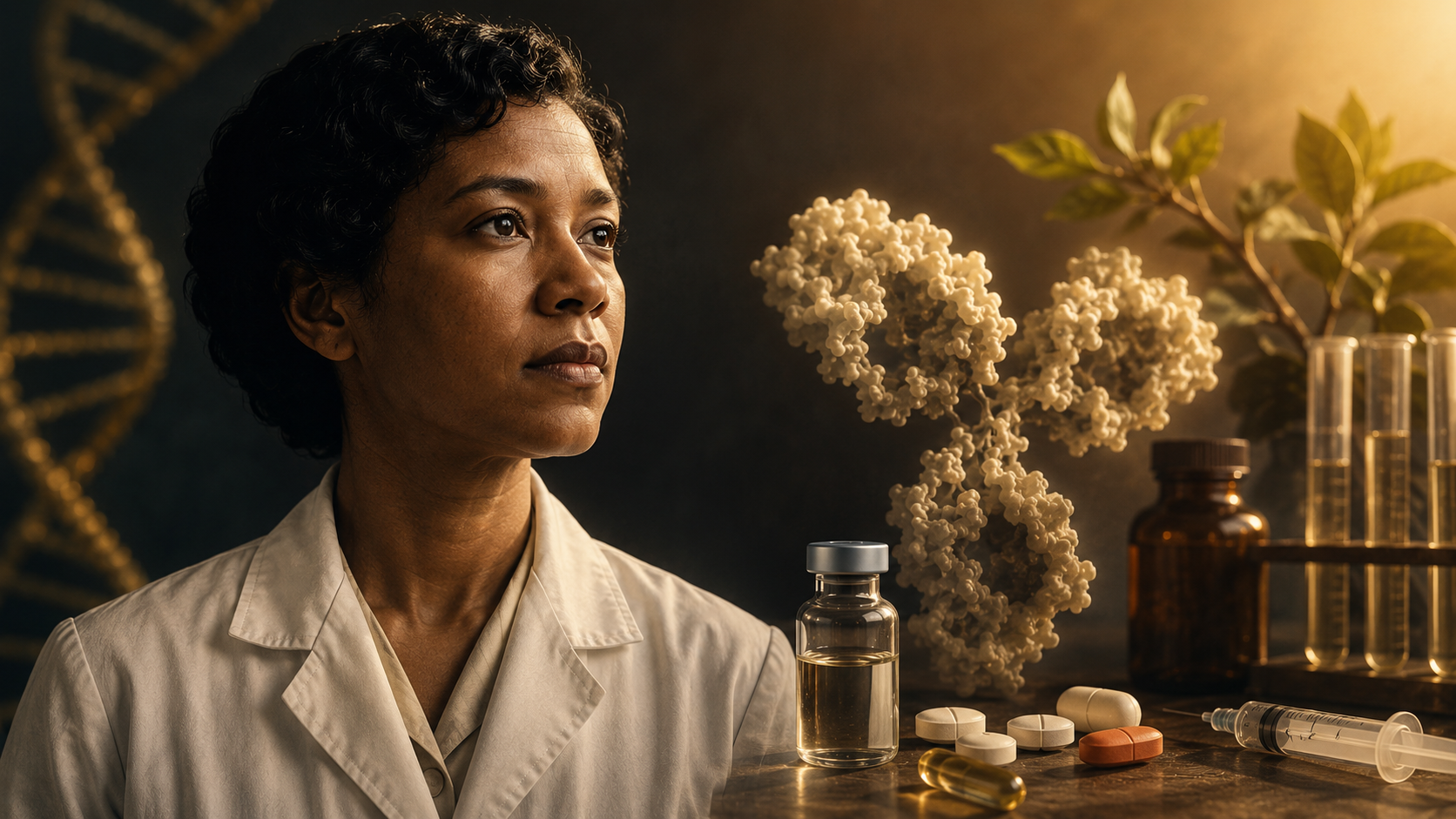
The Women Behind the Medicines That Changed Modern Healthcare
How scientific problems became treatments, diagnostics and technologies that changed what medicine could do
How scientific problems became treatments, diagnostics and technologies that changed what medicine could do
Modern medicine is full of things that seem inevitable once they exist.
A drug targets a cancer cell.
A blood test measures a hormone.
An infection is treated with an antimicrobial compound.
A vaccine teaches the immune system what to recognise before the real pathogen arrives.
We become accustomed to the result.
The route to it is usually less tidy.
A medicine rarely begins with someone deciding to "invent a cure." It begins with a narrower problem.
Why does this bacterium survive?
Which molecule is controlling this process?
What shape does this protein have?
Why is the immune system reacting?
Can a compound interrupt one biochemical pathway without destroying everything around it?
The questions are smaller than the consequences.
That is one of medicine's peculiar characteristics.
A scientist may spend years studying an obscure enzyme, a tropical plant, a crystal structure or a molecule that refuses to behave in the laboratory.
Then, somewhere further down the line, another person gets better.
Women have been involved at every stage of that transformation.
Alice Ball found a way to make an old treatment for leprosy more usable. Gertrude Elion helped replace indiscriminate drug discovery with something more deliberate. Dorothy Crowfoot Hodgkin revealed the structures of molecules medicine needed to understand. Rosalyn Yalow made tiny quantities of hormones measurable. Tu Youyou found a new antimalarial drug by combining historical clues with experimental testing. Katalin Karikó helped make messenger RNA medically useful.
These are not simply biographies of women who worked in medicine.
They are stories about problems medicine once could not solve.
And what changed when somebody finally found a way through.
When the Treatment Existed but Could Barely Be Used
Leprosy is one of humanity's oldest documented diseases.
For centuries, treatment was inadequate.
By the early twentieth century, physicians knew that oil from the seeds of the chaulmoogra tree could sometimes help patients with leprosy, now known as Hansen's disease.
There was a problem.
The oil was unpleasant to take orally.
Applied to the skin, it was poorly absorbed.
Injected, it was thick and difficult to administer.
Medicine had something that appeared to help.
It simply could not use it very well.
Alice Ball approached the problem as a chemist.
Working at the College of Hawaii in the 1910s, she investigated the chemical components of chaulmoogra oil and developed a method for converting its fatty acids into compounds that were more water-soluble and suitable for injection.
This became known as the Ball Method.
The treatment was not a modern cure in the sense we would use the word today. Antibiotic therapies later transformed the treatment of Hansen's disease much more profoundly.
But Ball's work made chaulmoogra-based treatment considerably more practical at a time when options were desperately limited.
And then the history became complicated.
Ball died in 1916.
She was twenty-four.
Her work was subsequently continued and published by Arthur Dean, president of the College of Hawaii, and for years the method became associated more closely with him than with Ball.
Eventually, historians restored her name to the story.
But the chemistry itself makes the deeper point.
Sometimes the breakthrough is not discovering an entirely new medicine.
It is making an existing one usable.
A treatment that cannot reach the patient is, pharmacologically speaking, not much of a treatment at all.
When Drugs Stopped Being Mostly an Exercise in Hope
For much of pharmaceutical history, drug discovery involved a great deal of trial and error.
A compound was found.
It was tested.
Something happened.
If the something was useful and the toxicity tolerable, medicine moved forward.
Gertrude Elion helped make the process more deliberate.
Working with George Hitchings at Burroughs Wellcome, Elion studied differences in the biochemical processes used by healthy human cells, cancer cells, bacteria, viruses and parasites.
The underlying idea was powerful.
If a diseased cell or pathogen depended on a biochemical pathway that could be disrupted selectively, perhaps a drug could interfere with the target without damaging the patient to the same degree.
This became an important form of rational drug design.
Elion and her colleagues developed or contributed to medicines used for several very different conditions.
Among them were drugs for leukaemia, organ transplantation, gout, herpesvirus infections and other diseases.
The range can make the work look like a collection of unrelated pharmaceutical successes.
It wasn't.
The common thread was biochemical specificity.
Medicine was learning to ask not merely whether a chemical killed something.
It was asking why.
That distinction changed pharmacology.
A chemotherapy drug that targets the rapid production of nucleic acids is not simply a poison selected because cancer cells dislike it.
An antiviral compound designed around viral replication is not an accident that happens to inconvenience a virus.
The more biology revealed about disease, the more drug design could exploit those differences.
Elion never completed a conventional PhD.
This did not prevent her from receiving the Nobel Prize in Physiology or Medicine in 1988, shared with Hitchings and James Black.
The degree was missing.
The medicines were not.
When Medicine Needed to See Molecules
A drug can work without anyone knowing exactly what it looks like.
Medicine becomes considerably more powerful once scientists can see the structure.
Dorothy Crowfoot Hodgkin spent much of her career solving molecules.
Not metaphorically.
Structurally.
Using X-ray crystallography, Hodgkin reconstructed the three-dimensional arrangements of atoms inside biologically important substances.
One of her early triumphs involved penicillin.
By the 1940s, penicillin had already transformed the treatment of bacterial infection.
But its precise molecular structure was disputed.
Hodgkin and her colleagues established it.
This mattered because chemistry depends on structure.
Knowing which atoms are present is not enough.
Their arrangement determines how a molecule behaves, how it interacts with other molecules and how chemists might alter it.
Hodgkin went on to determine the structure of vitamin B12, an extraordinarily complex molecule.
Then there was insulin.
She worked on that problem for decades.
The structure was eventually solved in 1969.
Insulin had been used medically since the 1920s, long before Hodgkin completed the structure.
Again, the chronology is instructive.
Medicine does not always wait for complete scientific understanding before using something that works.
But deeper understanding expands what can happen next.
Structural biology helped turn medicines from substances that produced effects into molecules whose interactions could increasingly be understood and engineered.
Hodgkin received the Nobel Prize in Chemistry in 1964.
Her work did not give doctors one medicine.
It helped give medicine a new way of seeing.
When a Tiny Quantity Had to Be Measured
Some of the most important molecules in the human body exist in quantities so small that older laboratory methods could barely detect them.
Hormones are particularly inconsiderate in this respect.
A tiny concentration can have enormous physiological consequences.
But if you cannot measure the concentration accurately, understanding what is happening becomes difficult.
Rosalyn Yalow helped solve that problem.
Working with physician Solomon Berson, Yalow developed radioimmunoassay, or RIA.
The principle exploited something extremely useful about antibodies.
They bind selectively to particular molecules.
By combining antibody binding with radioactively labelled versions of a substance, researchers could determine how much of that substance was present in a blood sample.
The method was astonishingly sensitive.
Suddenly, concentrations of hormones and other biological molecules that had previously been extremely difficult to measure became accessible to routine investigation.
The consequences spread widely through medicine.
Insulin could be measured.
Thyroid hormones could be measured.
Other hormones, drugs and biological markers followed.
RIA helped transform endocrinology and diagnostic medicine.
The breakthrough is easy to underestimate because it did not cure a disease.
It did something medicine requires before treatment even begins.
It measured.
Diagnosis depends on measurement.
So does monitoring.
So does understanding whether a therapy is working.
Modern medicine is full of impressive interventions.
Some of its most important technologies simply tell us what is happening.
Yalow received the Nobel Prize in Physiology or Medicine in 1977.
A technique for detecting almost vanishing quantities had become impossible to ignore.
When an Ancient Text Contained a Useful Clue
Malaria has killed human beings for thousands of years.
By the twentieth century, medicine had treatments.
The parasite evolved resistance to some of them.
The problem returned.
During the 1960s, China launched a large programme to search for new antimalarial drugs.
Tu Youyou became one of the scientists involved.
Her team examined traditional Chinese medical texts and tested hundreds of preparations derived from plants and other sources.
One plant kept attracting attention.
Sweet wormwood, Artemisia annua.
Extracts sometimes worked against malaria parasites.
Sometimes they didn't.
The inconsistency was the clue.
Tu returned to an ancient description of how the plant had been prepared.
Rather than boiling it aggressively, the historical text described soaking it.
Perhaps heat was destroying the useful compound.
Tu's team altered the extraction process, using lower temperatures.
The result became much more effective.
The active compound was eventually identified as artemisinin.
Artemisinin and its derivatives became central to modern malaria treatment, particularly in combination therapies designed to reduce the risk of resistance.
The global consequence has been enormous.
But the story is often simplified in an unhelpful direction.
Traditional medicine knew the cure.
Modern science rediscovered it.
That is not quite what happened.
The historical text offered a clue.
Tu's achievement was treating that clue as something to investigate experimentally rather than something to accept on authority.
Many traditional remedies do not work.
Some contain active compounds.
Science is the process that helps distinguish between them.
The old text suggested where to look.
The experiment decided what mattered.
When Cancer Treatment Became More Selective
Cancer presents medicine with a cruel problem.
Cancer cells are human cells.
They are not foreign bacteria or parasites that can simply be attacked as outsiders.
They share enormous amounts of biology with the healthy tissues around them.
So how do you kill the cancer without killing the patient?
Gertrude Elion's work had already helped establish one answer: exploit biochemical differences.
Later generations pushed the idea further.
One of the most important changes in cancer medicine came from identifying specific molecular abnormalities driving particular cancers.
Now the problem could sometimes be reframed.
Not simply:
How do we kill rapidly dividing cells?
But:
Which altered molecule is making these particular cells grow?
This shift produced targeted therapies.
The history involves many scientists and many drugs, and it resists assignment to one person.
That is worth emphasising because modern medicine increasingly emerges from teams rather than solitary discoverers.
Cancer treatment became a demonstration of what happens when genetics, structural biology and pharmacology converge.
A tumour could be classified not only by where it appeared in the body but by which molecular changes it carried.
The disease acquired an internal identity.
Treatment could follow.
The result is still imperfect.
Cancer is not one disease.
Tumours evolve.
Resistance develops.
Targeted drugs can fail.
But the basic transformation remains enormous.
Medicine learned to treat some cancers according to the molecular machinery that had gone wrong inside them.
The closer scientists looked, the less useful the word "cancer" became on its own.
When the Immune System Became a Measurement Tool
Rosalyn Yalow's work illustrates another recurring theme in modern medicine.
The immune system is not only something medicine treats.
It can also be used as technology.
Antibodies recognise molecular shapes with remarkable specificity.
That property became the basis not only for radioimmunoassay but for a much larger class of diagnostic and therapeutic tools.
Modern laboratory medicine depends heavily on antibody-based testing.
Pregnancy tests.
Hormone assays.
Infectious disease tests.
Cancer markers.
The familiar line appearing on a lateral-flow test belongs to the same broad conceptual world: exploit a biological recognition system to detect something humans cannot see directly.
Later, antibodies themselves became medicines.
Monoclonal antibody therapies can target particular proteins involved in cancer, inflammatory disease and other conditions.
Again, no single scientist invented this entire field.
The important shift is conceptual.
The immune system evolved to recognise biological targets.
Medicine learned to borrow that ability.
The body became part of the laboratory equipment.
When a Vaccine Could Be Written as a Message
For most of vaccine history, vaccines involved presenting the immune system with some version or component of a pathogen.
Messenger RNA offered another possibility.
Do not manufacture the antigen first.
Give cells the instructions.
Katalin Karikó spent decades trying to make this idea practical.
Messenger RNA carries temporary genetic instructions from DNA to the cellular machinery that produces proteins.
In principle, synthetic mRNA could be designed to tell cells to manufacture a chosen protein.
In practice, the molecule created problems.
It was fragile.
It was difficult to deliver.
And the immune system had an inconvenient tendency to treat laboratory-produced RNA as something suspicious.
That last problem mattered enormously.
Cells possess innate immune sensors, including Toll-like receptors, capable of detecting particular forms of RNA associated with infection.
Synthetic mRNA could therefore provoke inflammatory responses before it had much chance to become medically useful.
Karikó and immunologist Drew Weissman investigated the problem.
Their work showed that replacing ordinary uridine in synthetic mRNA with modified nucleosides such as pseudouridine could reduce unwanted activation of innate immune pathways while preserving the message's ability to direct protein production.
The message could still be read.
The alarm became quieter.
This did not single-handedly create an mRNA vaccine.
Years of additional work were required: delivery systems, lipid nanoparticles, manufacturing methods, further modifications, clinical testing and contributions from researchers and companies around the world.
Then SARS-CoV-2 appeared.
The COVID-19 pandemic created a problem for which the mRNA platform was unusually well suited.
Once scientists knew the genetic sequence encoding the virus's spike protein, an mRNA vaccine could be designed to instruct human cells to produce that antigen temporarily.
The immune system could learn what to recognise without exposure to the whole virus.
Decades of work that had seemed specialised suddenly became global infrastructure.
Karikó and Weissman received the 2023 Nobel Prize in Physiology or Medicine.
The familiar version of the story is about persistence.
Scientist believes in unpopular idea.
Scientist refuses to give up.
Scientist is vindicated.
It is appealing.
It is also incomplete.
Persistence matters.
So do funding, institutions, collaborators, timing, delivery technologies, manufacturing and the accumulated work of scientists who never become part of the headline.
Medicine rarely arrives in one heroic leap.
It accumulates until suddenly the accumulation is useful.
When Disease Becomes a Scientific Problem
The medicines in this history look very different.
A chemically modified plant oil.
Anticancer drugs.
Antivirals.
Antimalarials.
Insulin structure.
mRNA vaccines.
The temptation is to organise them by disease.
Leprosy.
Cancer.
Malaria.
Diabetes.
Viral infection.
That is how patients encounter medicine.
Researchers often encounter something else.
A solubility problem.
A molecular-structure problem.
A metabolic pathway.
A measurement problem.
A delivery problem.
An immune-recognition problem.
This is one of the reasons medical breakthroughs can arrive from apparently unrelated science.
The scientist solving the structural chemistry of a molecule may not be treating the patient.
The scientist studying how an antibody binds may not be designing a diagnostic test yet.
The scientist modifying RNA may not know which disease will eventually make the platform indispensable.
Modern healthcare is built from these layers.
Disease produces the urgency.
Science identifies the problem underneath it.
Medicine finds a way to intervene.
The Treatment Is Only the End of the Story
When we talk about medical progress, we tend to begin with the patient.
This is reasonable.
The patient is the point.
But historically, the patient often appears at the end of a very long chain.
Before Alice Ball's treatment could reach a person with Hansen's disease, chemistry had to make an oily compound injectable.
Before rational drug design could produce medicines, scientists had to understand enough biochemistry to identify useful differences between cells.
Before molecular structures could guide medicine, X-ray crystallography had to make invisible architecture calculable.
Before hormone disorders could be diagnosed precisely, laboratories needed a way to measure substances present in almost absurdly small quantities.
Before artemisinin could become a modern antimalarial treatment, a traditional remedy had to be treated as a hypothesis rather than folklore.
Before mRNA could become a vaccine platform, researchers had to understand why cells reacted badly to synthetic RNA and how to change the molecule without destroying its message.
The final medicine is visible.
The scientific problems underneath it usually are not.
That may be why the history of medicine so easily becomes a history of famous doctors and miracle drugs.
The laboratory disappears.
So do the chemists, biochemists, physicists and molecular biologists whose discoveries made the treatment possible.
Women were not a decorative addition to that history.
They were solving the problems underneath it.
The Medicines Changed. So Did the Meaning of Medicine.
There was a time when a medicine was largely something administered to a sick person in the hope that it would help.
Modern medicine is becoming something considerably more precise.
A molecule can be designed around a biochemical target.
A laboratory test can detect a substance at an extraordinarily low concentration.
A tumour can be classified by its molecular abnormalities.
An antibody can become a therapy.
A genetic message can become a vaccine.
The progression is not from primitive medicine to perfect medicine.
Modern healthcare remains full of uncertainty.
Drugs fail.
Pathogens evolve.
Cancers develop resistance.
Side effects persist.
Diseases remain incurable.
Science has not removed uncertainty from medicine.
It has made the uncertainty more specific.
And that may be one of its greatest achievements.
Alice Ball asked how a difficult treatment could be made usable.
Gertrude Elion asked where diseased cells and pathogens differed from healthy biology.
Dorothy Crowfoot Hodgkin asked what medically important molecules actually looked like.
Rosalyn Yalow asked how something almost impossibly scarce could be measured.
Tu Youyou asked why an old treatment sometimes worked and sometimes didn't.
Katalin Karikó asked whether a temporary genetic message could become medicine.
Different diseases.
Different centuries.
Different laboratories.
The same underlying habit.
Find the problem beneath the problem.
Then solve that.
The patient may never know the name of the scientist who did it.
Perhaps that is another sign that the medicine worked.